
Christianity Before Christ?
Why are there so many accounts of crucified "saviors" prior to Jesus the Messiah? Why are they so similar to the Gospel accounts even in minor details? Is Christianity merely a counterfeit of a more ancient savior-legend?
Noah Preached About A Coming SaviorOriginally, all nations dwelt together in a common society at Babel about 2300 B.C. This would account for the close similarity of all branches of pagan religions. Noah preached (2 Pet. 2:5) about a coming Savior (Gen.3:15) who would be born of a virgin, live a sinless life, be crucified, die (Rev. 13:8) and live again. Perhaps he received this knowledge from the gospel in the stars -- unless it was passed down from Adam generation to generation. But in any case, we actually find the gospel in Genesis 5 by simply listing the ten men's names and their meanings from Adam to Noah. Notice: Adam (Man), Seth (is appointed), Enosh (mortal), Kenan (sorrow). Mahalalel (The blessed God), Jared (shall come down), Enoch (teaching). Methuselah (His death shall bring), Lamech (the despairing), Noah (rest or comfort). Is God telling us that the pre-flood world heard the Gospel? We think so. Naamah-Isis, Noah's wife (where we got our word "nemesis"), corrupted and institutionalized this theme into human sacrifice and cannibalism. Then God scattered mankind at the tower of Babel. The people of India wrote the Hindoo Baghavat Gita about Krishna who was supposedly crucified in 1200 B.C. and the Syrians wrote about their "savior" Tammuz whom they say was crucified 1160 B.C. and the Mexicans mentioned their Quexalcotel 587 B.C. and the Greeks their Prometheus (547 B.C.) as told by Seneca and Hesiod. The Persians also had their "savior" called Mithra and they claim he was crucified in 600 B.C. God, born of a virgin, crushes the serpent's head but suffers death from its venom. This is a common tradition in all nations. For many more examples, see L 'Origin des Cults by Depuis; or Forerunners and Rivals Of Christianity by F. Legge; or see Pagan Resurrection Myths and the Resurrection of Jesus by Leon McKenzie; or Deceptions and Myths of the Bible by Lloyd M. Graham, or the Golden Bough by James Frazer; or see The World's Sixteen Crucified Saviors by Kersey Graves. Each society annually in the spring commemorated this event with the sacrifice of the king's firstborn son on a cross to ensure crop fertility. The victim's flesh was eaten and his blood drunk.
Gospel in the Stars Understood by Abraham
Originally the stars were intended by God to "be for SIGNS" of the Zodiac (Gen. 1:14). God calls all the stars "by their NAMES" (Ps. 147:4). He told Abraham, "Look toward heaven and recount the STORY of the star NAMES in order. They will tell you about your descendant " (Gen. 15:5). Furthermore, each of the twelve signs was associated with one of the twelve tribes of Israel (Gen. 37:9-11; Gen. 49 ; Deut. 33). This is NOT ASTROLOGY (Isa. 47:13-14). Deuteronomy 4:19 condemns astrology which is defined as "WORSHIP" of the sun, moon and stars. Psalm 19:1-4 says, "The heavens declare the glory of God; the skies proclaim the work of his hands. Day after day they pour forth speech; night after night they display knowledge (using sign language). They have no (verbal) speech, they use no (vocal) words; no sound is heard from them. Yet their voice (sign language) goes out into all the earth, their (picto-graphic) words to the ends of the world."
Yes, "By his Spirit he hath garnished the heavens; his hand hath formed the crooked serpent (Drago Constellation)" (Job 26:13). God made the zodiac (Job 9:9). Josephus tells us that righteous Seth invented astronomy (Ant. 1:2:3). Yes, "their sound went into all the earth" (Rom. 10:18). In Acts 17:27-28, Paul quoted from Aratus's poem Phaenomina written about the constellations around 270 B.C. It was these STAR NAMES that "preached the gospel unto Abraham" (Gal. 3:8). Ancient Egyptian zodiacs such as the one in the Tombs of the Kings at Karnak have the image of a sphinx (woman's head with lion's body whose name means "bind together" from Greek "sphiggo") between Leo and Virgo showing where the circle begins and ends. In the zodiac of Denderah (2000 B.C., a picture of a sphinx is also placed between Virgo and Leo. But how can we understand this sign language? Start reading at Virgo with the brightest star in that constellation and end with the faintest star. Then move to Libra and do the same. Etcetera. When the names are put together into a sentence in order of each star's brightness, a sentence is constructed for each constellation. The constellations begin with our Lord's birth from VIRGO (a virgin) and end with His return as the "LION of the tribe of Judah." "Thy will be done on earth as it is in (the astronomical) HEAVEN" (Matt. 6:10). We are instructed to "measure the (360-degree celestial) temple of God" (11:1) counting degrees clockwise.
The original meaning of the zodiac was that a Virgin (Virgo pregnant with sun) would give birth to a son of God pictured by the actual sun as it passed through her body. Divine scales of justice (sun in Libra) would require His death (Scorpio's sting is orange swelling sore) for the sins of humanity. But the dual-natured Savior would conquer death (Sagittarius' face shining like the sun) and give life to his followers (a living fish) by his sacrifice (Capricorn goat a burnt sacrifice) and let them drink the living waters of the Holy Spirit (Aquarius pouring out the sun) which then breaks the bands of sin (sun cutting Pisces' bands) because the Lamb was wounded for our transgression (sun wound in Aries' side). He will return (Taurus with golden sun crown on his head), this dual-natured Savior with fiery words (Gemini), and shelter his people (sun in Cancer) from the day of Wrath when this "Lion of the tribe of Judah" will destroy that old serpent the Devil (Leo pouncing on Hydra).
Even the names of Abraham's sons indicate a knowledge of the Gospel prior to 1900 B.C. The order and meaning of the names of the sons: "See a son (Reuben), hear him (Simeon), join him (Levi), praise him (Judah), dwell with him (Zebulun). He will reward (Issachar), at the judgment (Dan), in a company (Gad) of blessed ones (Asher), who have wrestled (Naphtali) and been added (Joseph) to the son of my right hand (Benjamin)."
Firstborn Son Of The King Sacrificed
In
primitive days it was the custom in many lands for a KING or ruler to
put his own SON to death as a sacrifice to the tribal god. God
tested Abraham in this way. Abraham attempted to sacrifice his SON Isaac
(Gen. 22:1-19). Arab legend says Ishmael was nearly sacrificed by his
father also (Weil's Biblical Legends of the Mussulmans, p.62). Moses actually
taught the substitution of a lamb for the FIRSTBORN SON (Ex. 34:20). King
David attempted to stop a famine by sacrificing seven princely SONS of
KING Saul, and hanging them up before the Lord (2 Sam. 21:9). KING Mesha
of Moab sacrificed his ELDEST SON (2 Ki. 3:27). KING Hiel sacrificed his
SONS at the foundation of Jericho (1 Ki. 16:34). Both KINGS Ahaz and Manasseh
incinerated their SONS in sacrificial fire (2 Ch. 28:3; 33:6). The Carthaginians,
who originally came from Syria, also had this custom: Hamilcar sacrificed
his SON at the seige of Agrigentum (Diodorus 13:86) and Maleus, a Carthaginian
general, crucified his SON as a sacrifice to Baal (Justin 18:7). Maleus
dressed up his SON as a ROYAL personage before crucifying him. Philo
of Byblus says it was customary for the KING to give his beloved SON to
die for the nation as a ransom offered to the avenging devils. The
words of the prophet Micah may be taken as the custom of that day: "Shall
I give my FIRSTBORN for my transgression, the fruit of my body for the
sin of my soul?" (Micah 6:7).
Crucified At Spring Passover Festival
King David HANGED
the sons of king Saul "at the beginning of the barley harvest"
and this harvest begins in the plain of Jericho and in the Jordan Valley,
at about the time of PASSOVER (2 Sam. 21:9) showing a connection.
Victims were sacrificed
with mystic rites (Eusebius Preparatio Evang.1:10,29).
Lent? Sunrise services? Easter eggs? Hot cross buns? Porphyry tells us
that Phoenician history is full of such sacrifices
(De Abstinentia 2:56). A certain Jesus ben Pandira was stoned to death
and HUNG up on a TREE on the eve of PASSOVER in the reign of Alexander
Jannaeus about 100 B.C. Thus there is reason to suppose that the ancient
custom of human sacrifice of a King's son performed annually at the SPRING
FESTIVAL survived in modified form with the execution of a condemned criminal
dressed up like a King at this PASSOVER time. (More on this later.) This
would account for Caiaphas' remark that it was expedient, presumably at
PASSOVER time, that a man should be sacrificed for the good of the nation
(John 11:50,55). In this regard it is interesting to notice that the writer
of Acts generally speaks of Jesus as having been slain and then "HANGED
on a TREE" as though this were a common phrase coming readily to
his mind (2 Sam. 21:9; Josh. 8:29; 10:26; etc.). and the word "HANGED"
is frequently used in Greek to denote CRUCIFIXION (Frazer's Golden Bough
1:226, note). In the holy groves of Upsala men were sacrificed by being
HUNG up on the sacred TREES (Adam of Bremen, Descriptio insularum Aquilonis,
27). The ancient Gauls CRUCIFIED the human beings sacrificed to their
gods (Strabo 4:4:5).
Called By The Title "Bar Abbas"
The king was, in early times, usually regarded as a personification of the tribal god, and hence as the divine FATHER of his people, and his SON who was sacrificed was thus the "Son of the Father" or "BAR ABBAS" in Hebrew. This would explain the curious Gospel story of Barabbas. Frazer pointed out "BARABBAS" was certainly not the personal name of any one criminal, but was the traditional name for the victim in an annual human sacrifice or criminal execution as the case may be. Philo Judaeus (Against Flaccus ch. 6), writing in the days of Agrippa, about 40 A.D., tells us that the mob at Alexandria dressed up a crazy old man, putting a sham crown on his head, a scepter in his hand, and a purple robe over his body, and hailed him as KARABBAS, an obvious miswriting for BARABBAS, and as Maris, the Syrian word for a royal personage.
Two Attendants Also Killed
Although
only one man represented the actual Bar Abbas, it must have been usual
to sacrifice others with him; for it was customary in primitive days for
an important person to be accompanied at death by SERVANTS who must therefore
also die in order to attend him in the next world (Herodotus 4:71). Thus,
TWO MEN were crucified with Jesus, one on his right and one on his left.
Moreover, in a fragment of Ctesias, it is recorded that the Egyptian usurper
Inarus was crucified by Artaxerxes I between TWO THIEVES; and a Persian
saint, Hitzibouzit, of unknown date, is said to have been "offered
up as a sacrifice between TWO MALEFACTORS on a hill-top facing the sun"
(Conybeare, Apology and Acts of Appolonius, p.270).
A Criminal Was Substituted
By
the time the Romans came along, the spring festival had exchanged the
king's son for an annual mock-king where a criminal was made into a human
sacrifice to ensure crop fertility.
CRIMINALS condemned to death were SUBSTITUTED for the royal prince. Thus
in the Babylonian Sacaea a CRIMINAL was dressed up in royal robes to represent
a prince, a crown being placed on his head, and was scourged and then
crucified or hanged (J.M. Robertson, Pagan Christs, p.145). At Rhodes
a CRIMINAL was similarly sacrificed at the Kronian festival (Porphyry
De Abstinentia 2:54), in commemoration, obviously, of the sacrifice by
Kronos of his royal son Ieoud. In the Kronos legend Ieoud was dressed
in royal robes before being sacrificed. The victims of these human sacrifices
were generally crucified, or else killed and then "hung on a tree,"
as in the various hangings before the Lord mentioned in the Bible (2 Sam.
21:9; Josh. 8:29; 10:26; etc.). Even the "Lord of Misrule" in
Medeival England's December 25th celebrations and "King of the Carnival"
or "Rex" in today's Mardi Gras in New Orleans can be traced
back to this human sacrifice in the primitive fertility rite at the turn
of the year, ensuring that the soil would continue to be productive (Celebrations
by Robert J. Myers). One of the Saturnalia amusements was the election of a mock king (Tacitus Annals13:15; Arrian Diss. Epictet. 1:25; Lucian Saturn. 4) which recalls the characteristic ceremony of twelfth-night.
Palestine, like other
provinces of Rome, practiced a custom where a criminal was sacrificed
in place of the primitive royal "Son of the Father" or Bar Abbas.
The significance of dressing up our Lord as a king, and of the inscription
"The King of the Jews," and the mock crown of thorns and a mock
scepter in his hand all become apparent.
More proof is the peculiar fact that he was executed by crucifixion when the punishment for blasphemy and heresy was death by decapitation (as in the case of John the Baptist) or stoning. The execution took place on the eve of Passover, yet crucifixions were slow torture often lasting several days before death released the sufferer. Thus the fact that an ordinary crucifixion would be held over till after the festival makes this crucifixion very unusual. Even more unusual is the fact that two criminals were crucified with him. Finally the release of a condemned criminal "Barabbas" whose place he took.
Those who argue that the Gospel story of the crucifixion is too similar to previous ancient pagan accounts of human sacrifice to be believed are misinformed. That is the very reason it is genuine and authentic. It was human sacrifice exactly as the pagan rituals had practiced it for thousands of years.
Cannibalism
Became Communion
The name "CANNIBAL" (Cahna Baal) is another word which means
"Baal Priest" The literal meaning of BONFIRE is "BONE FIRE"
[M.E. bonefyre, bone fire, later funeral pyre] because such a ritual fire
came from the SACRIFICE of HUMANS. In Jeremiah 19:5-6 we read, "They
have built also the high places of Baal, to BURN their SONS with fire
for burnt offerings unto Baal which I commanded not, nor spake it, neither
came it into my mind: Therefore ... this place shall no more be called
Tophet, nor the valley of the son of Hinnom, but the valley of slaughter."
The victim was crucified and then his FLESH was EATEN and his BLOOD DRUNK
by priests of Baal known as Cannibals. The priests of Baal killed children
(Isaiah 57:5; Ezekiel 16:20; Tertullian Apologetics 9; Horace Epod. 5;
Procopius Gothica 1:25; Pausanias 9:8). Minucius Felix said that ""Even
the Romans worship Jupiter Latiaris with manslaughter" (Octavius
p.108). Pliny praises the Roman people for "having put an end to
those monstrous rites" in which "to murder a man was to do an
act of the greatest DEVOUTNESS, and to eat his flesh was to secure the
highest BLESSINGS of health" (Nat. Hist. 30:4). Instead they called
bread Ceres and wine Dionysos (Cicero De Nat. Deor. 3:16). A pagan COMMUNION.
Possibly following the same theme of cannibalism as practiced by the surrounding nations with their yearly mock-kings who were eaten, Jesus himself endorsed the ordinance for only himself by saying, "He who EATETH my FLESH, and DRINKETH my BLOOD, hath eternal life" (John 6:53). Jesus lost many disciples who were offended by this remark (John 6:66) because they thought he was now creating another cult of human sacrifice and cannibalism.
But
the same Eternal who in Revelation 22:16 called himself "the bright
and MORNING STAR" rather than the "goddess" ISHTAR and
who calls himself the "BRANCH" (Zech 3:8; 6:12) rather than
the Ivy branch of BACCHUS (Hesychius p.179); the same Eternal who employed
a FISH to transport Jonah onto a beach of Fish-worshipping Ninevites to
show He was more powerful than DAGON; the same Eternal who created "a
thick DARKNESS in ... Egypt" (Ex.10:22) to show that he was greater
than the Egyptian Sun-god RA whose name He then took: "Sun of righteousness
... with healing in his wings" (Mal. 4:2) and the same Eternal who
in Psalm 68:4 "RIDES on the CLOUDS" rather than BAAL of Canaanite
Ugarit text mythology who claimed this ability, now may have used the
cannibalistic human sacrifices of pagan, crucified "SAVIOR"
kings to further illustrate that He ALONE is the king who can SAVE. The Book of Revelation used Chaldean "ASTROLOGY" throughout and turned it to the glory of God.

Historical Jesus
Is there any evidence, outside the Bible, that Jesus Christ really lived?
1.) Josephus' Antiquities of the Jews, written around 93–94 AD, includes two references to the biblical Jesus in Books 18 and 20:
"About this time there lived Jesus, a wise man, if indeed one ought to call him a man. For he was one who performed surprising deeds and was a teacher of such people as accept the truth gladly. He won over many Jews and many of the Greeks. He was the Messiah. And when, upon the accusation of the principal men among us, Pilate had condemned him to a cross, those who had first come to love him did not cease. He appeared to them spending a third day restored to life, for the prophets of God had foretold these things and a thousand other marvels about him. And the tribe of the Christians, so called after him, has still to this day not disappeared".(Antiquities, 18.3.3 §63)
"the brother of Jesus, who was called Christ, whose name was James" (Antiquities 20.9.1).
Josephus called John the Baptist " the good man" (Antiquities, 18.5.2). Scholars recognize the genuineness of Josephus' account concerning the death of James, "the brother of Jesus who was called Christ" (Antiquities, 20.9.1).
2.) Justin Martyr, a second-century theologian, wrote: "Now there is a village in the land of the Jews, 35 stadia from Jerusaiem, in which Christ was born, as you can ascertain also from the registries of the taxing under Cyrenius your first procurator in Judea" (First Apology, chapter 34). Justin was referring to public records that existed in his day to demonstrate that Jesus was born in Judea. Of course, one would expect that a religionist such as Justin would naturally support Jesus' authenticity as a historical person. But what about a historian who despised Christians?
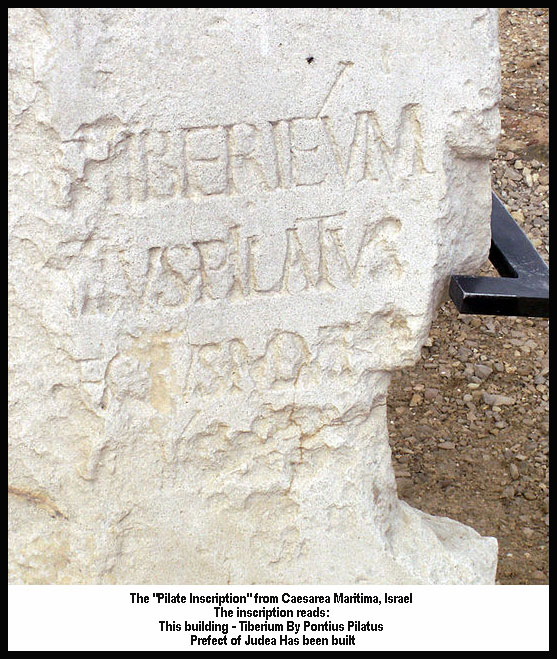
3.) Cornelius Tacitus, a Roman senator, consul, governor of the province of Asia, and historian, referred to 'Christus' and his execution by Pontius Pilate in his Annals (written ca. AD 116), book 15, chapter 44. (cf. Luke 3:1; 23:24,33) The very negative tone of Tacitus' comments on Christians make the passage extremely unlikely to have been forged by a Christian scribe.
"Such indeed were the precautions of human wisdom. The next thing was to seek means of propitiating the gods, and recourse was had to the Sibylline books, by the direction of which prayers were offered to Vulcanus, Ceres, and Proserpina. Juno, too, was entreated by the matrons, first, in the Capitol, then on the nearest part of the coast, whence water was procured to sprinkle the fane and image of the goddess. And there were sacred banquets and nightly vigils celebrated by married women. But all human efforts, all the lavish gifts of the emperor, and the propitiations of the gods, did not banish the sinister belief that the conflagration was the result of an order. Consequently, to get rid of the report, Nero fastened the guilt and inflicted the most exquisite tortures on a class hated for their abominations, called Christians by the populace. Christus, from whom the name had its origin, suffered the extreme penalty during the reign of Tiberius at the hands of one of our procurators, Pontius Pilatus, and a most mischievous superstition, thus checked for the moment, again broke out not only in Judaea, the first source of the evil, but even in Rome, where all things hideous and shameful from every part of the world find their centre and become popular. Accordingly, an arrest was first made of all who pleaded guilty; then, upon their information, an immense multitude was convicted, not so much of the crime of firing the city, as of hatred against mankind. Mockery of every sort was added to their deaths. Covered with the skins of beasts, they were torn by dogs and perished, or were nailed to crosses, or were doomed to the flames and burnt, to serve as a nightly illumination, when daylight had expired. Nero offered his gardens for the spectacle, and was exhibiting a show in the circus, while he mingled with the people in the dress of a charioteer or stood aloft on a car. Hence, even for criminals who deserved extreme and exemplary punishment, there arose a feeling of compassion; for it was not, as it seemed, for the public good, but to glut one man's cruelty, that they were being destroyed." (Annals 15:44)
4.) We also have the testimony of another Roman, the fourth-century emperor Julian the Apostate (so called because he turned from Christianity after being brought up in it). He wrote a major work against Christianity in which he said this: "Jesus, whom you celebrate, was one of Caesar's subjects. If you dispute it, I will prove it by and by; but it may be as well done now. For yourselves allow, that he was enrolled with his father and mother in the time of Cyrenius.... But Jesus having persuaded a few among you, and those the worst of men, has now been celebrated about 300 years; having done nothing in his life-time worthy of remembrance; unless anyone thinks it a mighty matter to heal lame and blind people, and exorcise demoniacs in the villages of Bethsaida and Bethany" (quoted in the polemic of Cyril of Alexandria against Julian, Cyril Contra Julian, vi, pages 213, 191). If Julian could have demonstrated that Jesus was not an authentic figure, he would have done so. Instead, he asserted that the proof that Jesus was one of Caesar's subjects was still available (the census records were apparently still in the imperial archives). Rather than denying that Jesus performed miracles, Julian simply down played these miracles as not being a "mighty matter."
5.) Jesus is also mentioned in the Talmud. The Jewish Encyclopedia terms as a mere "subterfuge" the attempt of atheists to deny those talmudic references that apply to Jesus of Nazareth. In the Talmud, Jesus is called "Son of Pandera," which obscures that He was born of a young virgin. Pandera, a word meaning "panther" or "leopard," is an anagram for the Greek word parthenos, meaning "virgin." The reference makes Jesus, figuratively, the son of a panther or leopard (the Greek word for "panther" is panther, which Jewish usage corrupted into the form pandera). The Talmud subtly calls the Gospel that Jesus preached an avengil, meaning a "blank paper," rather than referring to Jesus' message by the original word evangel, meaning "good news." Jesus brought the good news of the coming Kingdom of God! There are records of Jesus healing the blind, the halt and the leprous. The Talmud also mentions His walking on the sea. Jesus' miracles were not denied by the Jews. Instead, those who saw Jesus perform those miracles said He learned sorcery in Egypt. Jesus is called "dead dog," "the hanged one," " the sorcerer," "Balaam" and "Seducer." Notice the similarity between some of these epithets and the accusation in Matthew 12:24.
Next
Lesson: Did The Welch CYMRY Come from the Crimea? | Back
to Home | Email Us