Did the Welsh CYMRY Come From the Crimea?
Just as the prophet HOSEA married a wife named "GOMER" (Hos.1:3), so also it was during the reign of King HOSHEA that Israel first went into captivity as GHOMRI. Micah 6:15 condemns the northern Israelites for keeping the "statutes of OMRI." OMRI in Hebrew begins with the consonant "Agin," formerly called "Gayin" which was pronounced with a gutteral "H," that is "Gh" or "Kh." The Israelites would have pronounced OMRI as "GHOMRI" which became "KHUMRI" in Assyrian. "GIMIRI" was the Babylonian way of pronouncing CIMMERIANS or Scythians (Tomb of Darius; Behistun Rock in Persia). OMRI was evidently a strong king. The Assyrians called Israel after his name, BIT OMRI (Khumri)" (1968 edition, p.44 Langer's Encyc. of World History; Moabite Stone). He built Samaria the capital of the Ten Tribes (1 Ki. 16:25). Some scholars have suggested that KIMMERIM refers to "idolatrous" (KEMARIM) Israelites. On Shalmaneser's Black Obelisk, Jehu , king of Israel, is called "son of OMRI" (880 B.C.) Also called the Nimroud Obelisk, Jehu the son of Omri is literally Yahua-abil-KHUMREE. In the annals of Sargon, king of Assyria, the Israelites are called Beth-KHUMRI, and their city is called KHUMREE. An old marble tablet says: "Sargon, King of Assyria, came up against the city of Samaria, and against the tribes of Beth-KHUMRI, and carried into captivity into Assyria 27,280 families." In the "Western Asiatic Inscriptions of the British Museum" vol.3 p.10 occurs a fragmentary inscription of Tiglath-Pileser II who reigned in Assyria in 740 B.C.: "The land of BETH KHUMRI (Samaria) ... the population ... the goods of its people ... I sent to Assyria. Their king, Pekah, had been slain. I appointed Hosea over the kingdom ... I placed them under the Magian religion" (see 2 Ki.15:29; 17:6,22; 1 Chr.5:26). Israel was taken captive to "the cities of the Medes" (2 Ki.17:6).
Cimmerians in the Crimea Came From Media according to Herodotus 4:12
In the east Caucasus area we find the GUMRI River. Cappadocia in Anatolia,
west of the Caucasus, was called KAMIR by Moses of Chorene. Lempriere's
Classical Dictionary locates the CIMERII "near the Palus Maeotis"
(Sea of Azov) (p.149). Herodotus 4:11 places them NW of the Black Sea
(CIMMERIAN Sea) and in "CIMMERIA" (the Crimea) (4:12). Herodotus
says that the KHUMRI who dwelt in the CRIMEAN Peninsula had come from
Media but he says that Media wasn't their original home. Homer's Odyssey
11:14 places them on the Pontus, at the extremities of the ocean, covered
with mist at the northern region of the Euxine (the CRIMEAin 800 B.C.).
The CRIMEA was called in
ancient times Taurica and Tauric Scythia (Land
of the Bull). The Welsh triads state that the Welsh CYMRY came from a
region about Defrobani (i.e. Constantinople) and their Traditional Annals
of the Cymri, p. 25 speak of their sojourn "in the land of Hav, where
Constantinople now stands" (KIMMERIAN Bosporus).
They migrated
west to the KIMBRIC Chersonesus (Jutland) according to Plutarch (in Mario)
(also see Ptolemy and Tacitus). Modern names in Jutland are HIMMERLAND
and HIMMERSYSSEL. We find HIMBRIN and HIMMERSTEIN in Trondheim, Norway
and HYMBER in south Norway. Sweden has Uppland HIMBRAN (Uppsala). Some
went south to Italy. Plutarch says, "from these regions (Jutland),
when they came into Italy, they began their march, being anciently called
KIMMERIOI, and in process of time KIMBROI." They named UMBRIA in N.
Italy.
Cimbric Chersonesis (Denmark) Connected to Crimea According to Strabo
Both Strabo and Plato mention KIMMERIANS on the NW shore of Europe. M.
Guizot in The History Of France From Earliest Times to 1848 states, "From
the seventh to the fourth century B.C., a new population spread over Gaul,
not at once, but by a series of invasions, of which the two principal
took place at the two extremes of that epoch. They called themselves KYMRIANS
or KIMRIANS ... the name of a people whom the Greeks placed on the western
bank of the Black Sea and in the CIMMERIAN peninsula, called to this day
CRIMEA" (p.16). The two invasions would be 721 B.C. and 331 B.C. Then Strabo, on the authority of Possidonius, connected the ancient CIMMERIANS of the Meotis Lake with the CIMBRI of Denmark. Diodorus Siculus says, "The
CYMBRI of Denmark were the same people as the CIMMERI of Greece." "The earliest writer
who makes mention of these KIMBRI is Philemon, contemporary of Aristotle:
according to him, they called their ocean (the Baltic) Mori-Marusa, or
the DEAD SEA, up to the promontory of Rubeas" ("Histoire des
Gaulois," Thierry, Intro., p.56). Pliny affirms that "the CIMMERIANS , afterwards
called CYMRI, came from Asia Minor." Pliny 4:13 also says the Cimbri
called the Baltic "Dead Sea." No doubt because both were very
salty. To an island in the mouth of the Elb they gave the name HOLY-LAND
-- now called Heligoland. "The KYMBRI swore by a BRAZEN BULL, which
they carried with them" (Sharon Turner, vol.1, p.3, History Of The
Anglo-Saxons). Compare Ex. 32:4.
Welsh Cymry Came From Cimbric Chersonesis
Many of these CIMMERIANS from the CIMBRIC Chersonesis (Denmark) then migrated to the English county of CUMBERLAND
and NORTHUMBRIA and to Wales which was anciently known as CAMBRIA. In
Greek a double "mm" or even just an "m" was frequently
replaced by "mb" for euphonic reasons. For instance, "numerous" becomes "number." The modern Welsh call
themselves CYMRY. Homer places the CIMMERIANS in the British Isles. So does Diodorus Siculus
5:32 and Plutarch's Lives. Many classical authors say the CIMMERIANS are
found in extreme WESTERN EUROPE (Homer's Odyssey XI, 13-19; Herod.1:6,15,16,103
and 4:1,11, etc.; Strabo 1:20,61; 309; 11:494). The Welsh language is so closely allied with Hebrew that if you want to learn Hebrew, learn Welsh first. M. Margoliouth, LLD, Ph.D. said, "It would be difficult to adduce a single article, or form of construction, in the Hebrew grammar, but the same may be found in the Welsh ... and there are many whole sentences in both languages exactly the same in the very words." Dr. Stratton of Edinburgh even wrote a book called "The Affinity Between the Hebrew Language and the Celtic." Canon Lyson wrote "Our Vulgar Tongue" further supporting many similarities.
Professor Rawlinson admits that "the identity of the CYMRY of Wales with the CIMBRI of the Romans seems worthy to be accepted;" and further writes "that a people known to their neighbors as CIMMERII, GIMIRI, or probably GOMERIM, attained a considerable power in Western Asia and Eastern Europe within the period indicated by the date B.C. 800-600, is a fact which can scarcely be said to admit of a doubt." Also "It will be interesting to trace the history and migrations of these CIMMIRIANS -- a people which has an antiquity above 2500 years, and has spread from the Steppes of Ukraine to the mountains of Wales." Professor Rawlinson admits that the CYMRY of Wales are the same people as the CIMMERII of Western Asia of the 7th century B.C. Sir Henry Rawlinson goes further than his brother, saying "We have reasonable grounds for regarding the GIMIRI, or CIMMERIANS, who first appeared on the confines of Assyria and Medea in the seventh century (B.C.), and the Sacae of the Behistun Rock, nearly two centuries later, as identical with 'Beth KHUMREE of Samaria,' or the Ten Tribes of the House of Israel."
The Origin of the Kymry
The Greek "Kimeros" means a MIST or DARKNESS. "The Latin Cimmerius is applied to anything DARK or BLACK. Therefore, when we are commanded to "have no fellowship with the unfruitful works of DARKNESS" (Eph. 5:11 4655 skotos), it may refer to works of the CYMRY. The spiritual state of the Israelites deteriorated when cast out of God's sight. The Hebrew word CHEMARIM (2 Ki. 23:5; Hos. 10:5; Zeph. 1:4) refers to the IDOLATROUS PRIESTS of the House of Israel derived from the root signifying to be BLACK because they wore BLACK robes instead of being "arrayed in WHITE linen". Even the biblical phrase "outer DARKNESS" (4655 skotos) may refer to "outer SCYTHIA" or PHRYGIA or PELOPPONESIA, all places where Israel dwelt that also mean BLACK. Dan's son HUSHIM, who lived in Greece, means BLACK also. KYMRY is derived from the notorious King OMRI. "Ephraim is a cake not turned" (Hos. 7:8) meaning BURNED or BLACKENED -- KYMRY. Thus in Hebrew, Greek or Latin the word has the same meaning. Who is so BLACK as Israel who has rebelled against God? Hence, "the PEOPLE who walked in DARKNESS" (Isa. 9:2 --2822 choshek; Matt. 4:16 -- 4655 skotos) are Israelites located in SCYTHIA or CIMMERIA. Even today the CRIMEA is found in the BLACK Sea. Or in Greek, "People who sat in SKOTOS" or SCYTHIA "saw great light." Greek "SCOTOS" means "DARKNESS.
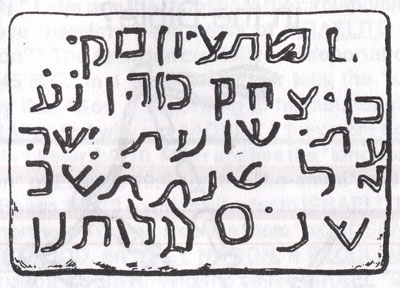
Gravestones in the Crimea
In several of these tombs, Hebrew manuscripts were found, some of which are translated by Professor Hannay as follows:"I am Jedudi, the son of Moses, the son of Jehudi the mighty, a man of the tribe of Naphtili, which was carried captive with the tribe of Simeon and other tribes of Israel, by Prince Shalmaneser, from Samaria during the reign of Hoshea, King of Israel. They were carried to Halah, to Habor -- which is Cabul -- to Gozan and to the Cheronesus -- which is the Crimea." (Haberman, Tracing Our Ancestors, p.129) Another Crimean tombstone reads: "We must inscribe here the wonders which God has done for us, who can recount what has happened unto us all during 1,500 years we have lived in this exile." Another tombstone reads: "To one of the faithful in Israel, Abraham ben Mar-Sinchah of Kertch, in the year of our exile 1682 (963 A.D.), when the envoys of the Rosh Meschek came from Kiou to our master ... Prince David, Halaah, Habor and Gozan, to which places Tiglath Pileser had exiled the sons of Reuben and Gad, and the half Tribe of Manasseh, and permitted to settle there, and from which they have been scattered through the entire East, even as far as China." (Haberman, p.130)These belong to the last comers: -- "Rabbi Moses Levi died in the 726 year of our exile." "Zadok the Levite, son of Moses, died 4,000 years after the Creation, 785 of our exile." This is the Karaite era of creation, making that event 3911 B.C.).
Next Lesson: Were The Greeks Israelites? | Back to Home | Email Us