Chapter 10 -- Greeks Escape Constantinople With Illuminating Manuscripts
Igniting Renaissance & Protestant Reformation
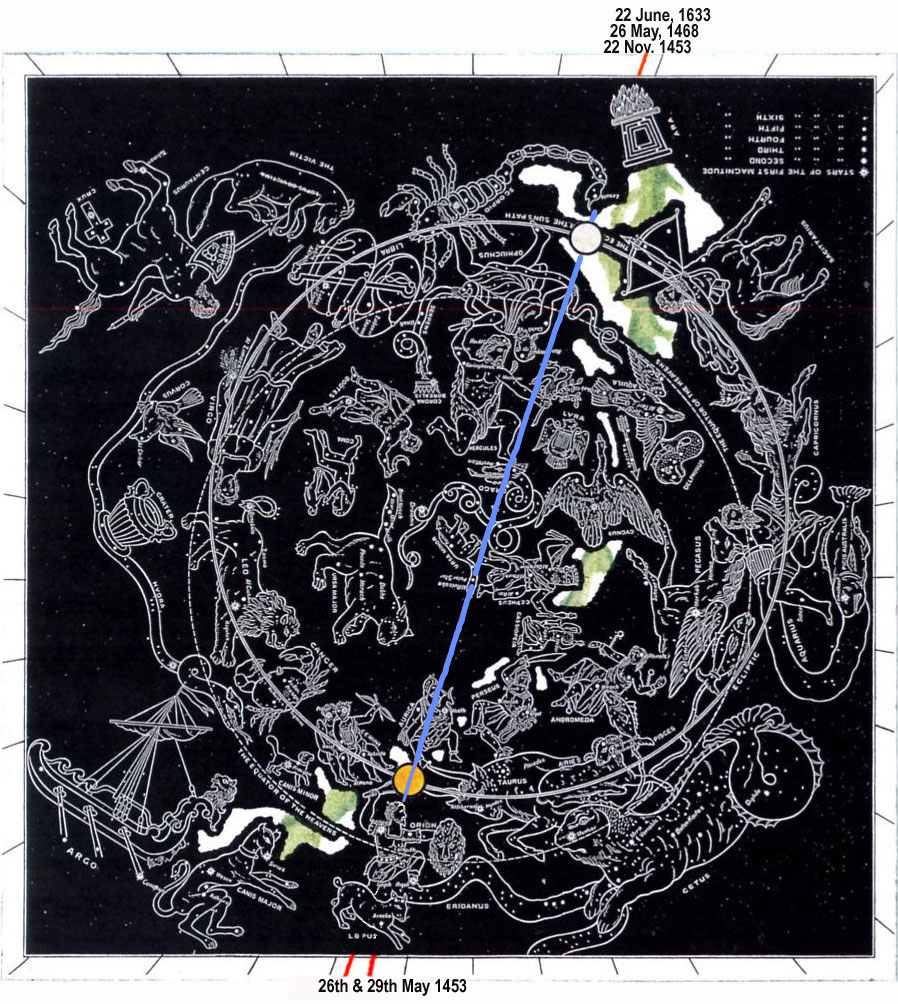
"And I saw another mighty angel (Orion) come down from heaven (outside Zodiac ecliptic), clothed with a (Milky Way) cloud: and a (Milky Way) rainbow was upon his head, and his face was as it were the sun, and his feet as pillars of fire (two tick marks): And he had in his hand a little book open (golden sun book opened with red radius line book mark) : and he set his right foot upon the sea (Eridanus), and his left foot on the earth" (10:1-2).
Astronomically, the rainbow is the Milky Way upon Orion's head when the sun is in Orion. He holds a scroll that has been transformed into an open book with golden pages and a red book mark (sun divided by red radius line). Orion's right foot is on the Eridanus ("the sea") and his left on the earth. This symbolizes the act of taking possession after 1000 years of darkness and stagnation from when the Decree of Emperor Justinian made the Bishop of Rome "Head of all the Holy Churches" in 533 till 1534 when Parliament abrogated Papal supremacy in England. "The earth is the Lord's, and the fulness thereof" (1 Cor. 10:26). Enlightenment and progress have occurred ever since. The Reformation broke up Roman-Catholic-dominated Europe by emancipating Britain, Germany, Scandinavia and Switzerland from its control. The primary cause of this freedom was opening the Bible to these nations in their native tongues. The most potent agency of this cause was the study of the New Testament in its original Greek, a language introduced into the universities of Europe by that great scholar, Erasmus.
Britain, and later the United States, by accepting the "little book" above all nations (Germany also did at first, but in modern times, by her "Higher Criticism," has repudiated it, with results we see today), has risen to be the greatest empire of all time, so that today Anglo-Saxons control the world. Yet at the time of the Reformation, England had neither navy nor colonies, her only foreign possession being Calais which was lost during the reign of Mary, and seemed helpless before the might of Spain and her Armada. Spain was then the greatest sea and colonizing power in the world. But Spain rejected the "little book" and where is the great Spanish Empire today? "Just as the Papacy has degraded the Spanish Peninsula, so has the Gospel exalted the British Isles" (D'Aubigne).
Freeing mankind from the yoke of ecclesiastical domination, to which the whole Western world had for many ages tamely submitted, caused people to lift their heads and breathe a free air. Determined to no longer yield implicit obedience to human authority, but to exercise their own understandings, and follow their own judgments, these bold reformers inquired into religion with an independent spirit and corrected errors and corruption in religion.
Historically, in Revelation 10:1-2 we read about an angel -- "the Angel of the Covenant" (Mal. 3:1; Matt. 17:2). His face is like the SUN because he is "The SUN of Righteousness" (Mal. 4:2) and "Our God is a consuming FIRE." The SUN ... is like a BRIDEGROOM coming out of his chamber, and rejoiceth like a strong man to RUN a RACE" (Ps. 19:4-5) (from Constantinople to western Europe). He is clothed with a CLOUD because Christ "cometh with CLOUDS" (Rev. 1:7) and "maketh the CLOUDS his CHARIOT" (Ps. 104:3). What are CLOUDS? "Thou shall be like a CLOUD to cover the land, thou, and all thy HORDES, and MANY PEOPLE with thee" "a GREAT COMPANY, and a MIGHTY ARMY" (Ez. 38:9,15; Jer. 4:13). "A CLOUD of witnesses" (Heb. 12:1) ran from Constantinople to western Europe concealed by a CLOUD of fog. A rainbow is upon his head because Christ has "a rainbow round about" his throne (Rev. 4:3) and he has feet like "pillars of fire" because Christ's feet are "as if they burned in a furnace" (Rev. 1:15). The Angel's VOICE is like the roar of a lion because He is the "Lion of the tribe of Judah" (Rev. 5:5). The Reformers here discovered the WORD as the "one Mediator between God and men." He has "a little open BOOK." A closed book is one not understood (Isa. 29:11-12; Dan. 12:4). Papal Rome had achieved this by keeping the BIBLE in Latin which few could read and hidden away in monasteries where few visited. Not content with this, the Papacy forbade the SCRIPTURES: In 1229 the Council of Toulouse stated, "We prohibit also the permitting of the laity to have the books of the OLD and NEW TESTAMENTS ... in the vulgar tongue" (common language). Even in England, by the 7th Constitution of Arundel (Oxford, 1408), "no unauthorized person shall translate any part of the Holy SCRIPTURE into English, or any other language." All reading of the WORD of GOD was also forbidden by this Constitution. The Council of Trent in 1559 prohibited reading the BIBLE without written permission because reading it "will cause more evil than good" (to the Papacy). The more the BIBLE is read, the less the Pope is obeyed. In other words, "the Lord shall consume (Him) with the Spirit of His mouth" (2 Th. 2:8) -- the BIBLE. None but Jesus could open this BOOK (Rev. 5:3) so He must be this Angel. He caused it to be printed and translated in English, Dutch, French, German, Spanish and Italian and be in every public library (typified by the Milky Way paper SCROLL spread open across the heaven so all can read with SUN-spool on one side and MOON-spool on other. This strongly indicates that the entire Bible is astronomical -- not just Revelation.). He set his right foot on western Europe ("Christian") and His left in eastern Europe (Moslem flooded Euphrates).
In 1453 the Greek scholars fled Constantinople because that eastern FOOT was flooded by the expanding EUPHRATES River otherwise known as the Moslem Turks. "How beautiful upon the mountains are the FEET of him that bringeth good tidings, that publisheth peace ... that publisheth salvation" (Isa. 52:7). What is the EUPHRATES? Isaiah 8:7-8 says waters of the river represent the people of the empire to which the river belongs -- "the strong flooding waters of the EUPHRATES, the king of Assyria" (NEB), "many and strong people" of Assyria at that time. Later the Turks conquered that area and the EUPHRATES then symbolized the TURKISH power. Hundreds of Greek scholars escaped to the FOOT on dry land which was the western Roman Empire in order to preserve the classical Greek literature manuscripts and Greek New Testament as an open book. These were bought up by Lorenzo "the magnificent" and other patrons of learning, and it was by the use of half-a dozon such manuscripts that Erasmus was able to publish an edition of the New Testament in its original language. The Turks had darkened the sun (Christ), but the light of the Reformation began shining. The pillars of fire and the cloud were leading Israel west toward the Promised Land and the RAINBOW promised that the flood of Turks would not destroy all Christianity. Where is this promise from God? Rev. 9:4,15 & Matt. 16:18. The Greek manuscripts were held high to preserve them from the Turkish flood. The three stars in Orion's belt may be Huss, Luther and Wycliffe. Gutenberg may be another. Erasmus and Zwingli are probably stars within this Orion constellation also. A quarter of the 180-copy edition of Johannes Gutenberg's first Bible printed in 1455 with movable type was printed on vellum (animal hyde). This may be the reason Orion is holding the hyde of a lion and the skin appears to be roaring. (180° = 180 copies).
Like a RAINBOW after a thunderstorm, light and knowledge came after oppressive ignorance. Both the Renaissance and the Reformation began after the Dark Ages at the start of the sixteenth century. Also, just as a RAINBOW was first seen after the worldwide flood in Noah's day as a sign that human life would not again be destroyed in a flood (Gen. 9:13), so this RAINBOW is seen as a sign regarding the Turkish flood -- that all "Christian" European life would not be destroyed by Moslem armies. When Constantinople fell to the Turks (1453), the Reformation followed. Why? First because the armies of "Christendom" (Catholics) were fully employed in warding off the Turkish menace, which had now expanded and was nearing its greatest limits, giving time for reform (Protestants) to spread and consolidate before persecution could crush the movement. Emperor Charles V, out of fear of the Turk, could not use his full army against Protestants. Also Constantinople had been the center of Greek Christianity, but with the advent of the Turks, scholars fled to the universities of Western Europe, taking with them their knowledge of Greek and also precious Greek manuscripts of the Bible. The result was a revival in the study of the classical languages, Greek being taught in Europe for the first time in 1458 A.D. Such a Renaissance or "New Learning" meant that the Bible which was written in Greek and Latin was studied afresh. In 1516 Erasmus published his famous Greek New Testament, thousands of copies of which were eagerly read by the numerous scholars who had already learned Greek. Translations of the Bible into the languages of the nations automatically followed so that, instead of being closed to the masses, it became an "OPEN BOOK" for all the Zodiac to read. The Milky Way paper SCROLL spread OPEN across the heaven so all can read with SUN-spool held up by Orion on one side and MOON-spool on other held by Scorpio. An English Bible was chained by law to every church (so it couldn't be stolen or burned).
Why was the angel "clothed with a CLOUD" with "feet like PILLARS of FIRE"? Because"the Lord went before them by day in a pillar of a CLOUD, to LEAD THEM the WAY; and by night in a PILLAR of FIRE, to GIVE THEM LIGHT" (Ex.13:21). The newly-printed and newly-translated SCRIPTURES LED these Protestants and GAVE THEM LIGHT. Also the invention of printing was made at the same time. The invention of movable type and how to make paper from rags and pulp all came when the Bible was rediscovered. Instead of a large book being hand-copied on vellum, a tedious and expensive process, the Bible now became a small book -- one of the first books to be printed. From the sixteenth century onward, millions of Bibles were printed. This is the "LOUD VOICE" of the "Lion of the tribe of Judah" (Rev. 10:3; 5:5). Notice the list of important dates as follows:
1453 -- Flight of Greek scholars to Western Europe
1454 -- Invention of printing in Germany
1458 -- Greek first taught in European Universities
1476 -- Caxton introduced printing into England. Also, first Greek grammar to be published in the west.
1516 -- Erasmus printed his Greek New Testament
1518 -- Zwingli printed the first Swiss New Testament
1522 -- Luther's New Testament in German
1526 -- Tynedale's English New Testament. A Swedish Bible.
1535 -- Coverdale's Complete English Bible.
1537 -- A Danish Bible. Matthew's English Bible.
1539 -- The "Great Bible" printed under Coverdale's supervision and placed by Royal Command in every church for parishoners' use.
1557 -- Geneva Bible (New Testament) published (1557 + 360 yrs = 1917 or "time of the end" [Dan 12:4] of "seven times" Gentile dominion of Jerusalem)
1611 -- The King James Authorized Version.
"On the 22nd May 1453, at the first hour of the night, there appeared a wonderful sign in the sky, telling Constantine the worthy Emperor of Constantinople that his proud empire was about to end. The MOON rose, being at this time FULL, so that it should have risen in the form of a complete CIRCLE; but it rose as if it were no more than a three-day moon (CRESCENT-shaped), with only a little of it showing, although the air was clear and unclouded, pure as crystal. The moon stayed in this form for about four hours, and gradually increased to a FULL CIRCLE, so that at the sixth hour of the night it was FULLY FORMED. When we Christians and the pagans had seen this marvelous sign, the Emperor of Constantinople was greatly afraid of it, and so were all his nobles, because the Greeks had a prophecy which said that Constantinople would never fall until the FULL MOON should give a sign, and this was the reason for the fear which the Greeks felt. But the Turks made great festivity in their camp for joy at the sign, because they believed that now victory was in their hands, as in truth it was.
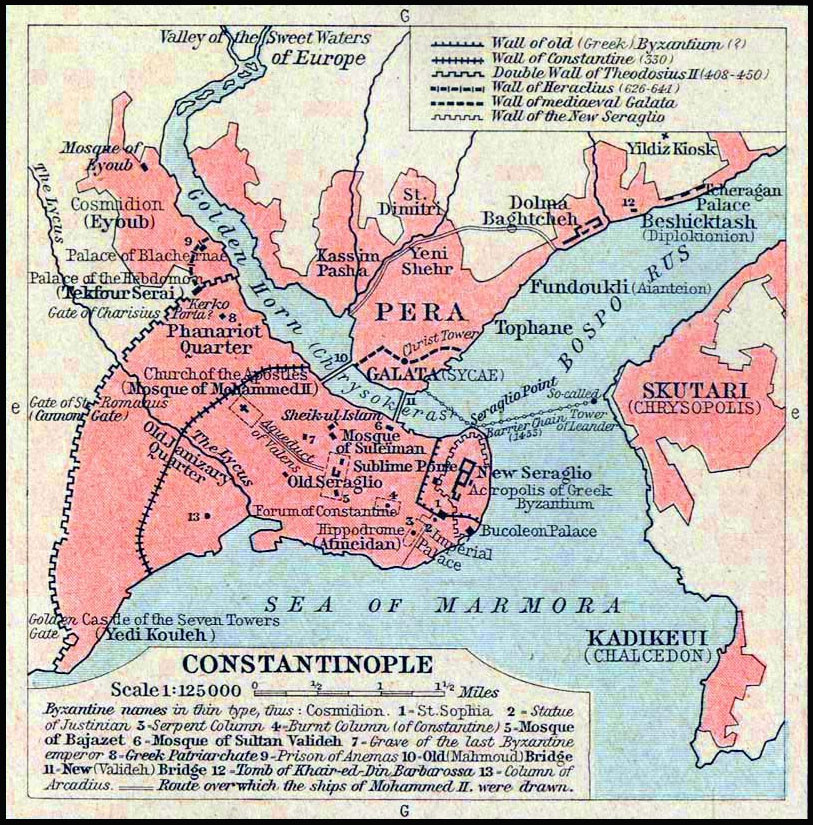
"On the 29th May, 1453, the last day of the siege, our Lord God decided, to the sorrow of the Greeks, that He was willing for the city to fall on this day into the hands of Mahomet Bey the Turk son of Murat, after the fashion and in the manner described below; and also our Eternal God was willing to make this decision in order to fulfill all the ancient prophecies, particularly the first prophecy made by Saint Constantine, who is on horseback on a column by the Church of Saint Sophia of this city, prophesying with his hand and saying, "From this direction will come the one who will undo me," pointing to Anatolia, that is Turkey. Another prophecy which he made was that when there should be an Emperor called Constantine son of Helen, under his rule Constantinople would be lost, and there was another prophecy that when the MOON should give a sign in the sky, within a few days the Turks would have Constantinople. All these three prophecies had come to pass, seeing that the Turks had passed into Greece, there was an Emperor called Constantine son of Helen, and the MOON had given a sign in the sky, so that God had determined to come to this decision against the Christians and particularly against the Empire of Constantinople" (Diary of the Siege of Constantinople, 1453 by Nicolo Barbaro).
"On May 22, 1453, the moon, symbol of Constantinople, rose in dark eclipse (with just a crescent showing -- comment mine), fulfilling a prophecy on the city's demise. Four days later (May 26), the whole city was blotted out by a THICK FOG, a condition unknown in that part of the world in May. When the FOG lifted that evening, a strange LIGHT was seen playing about the dome of the Hagia Sophia, and from the city walls LIGHTS were seen in the countryside to the West, far behind the Turkish camp. The LIGHT around the dome was interpreted by some as the HOLY SPIRIT departing from the Cathedral" (and going West). (Wikipedia, "Fall of Constantinople"). Therefore, it was probably on that very foggy night, May 26, 1453, that young Greek Orthodox scholars (Orion) fled Constantinople (came "down from heaven" or government capitol -- 10:1) secretly ("clothed with a CLOUD " of the Milky Way FOG hiding their escape from Constantinople -- 10:1). This was certainly a real-life GREEK OLYMPIC GAME for these GOLD-MEDAL champions (The sun symbolized a GOLD MEDAL -- 1 Cor. 3:12; the light blue sky a BLUE RIBBON -- Nu. 15:38) RUNNING for their lives, as they must have been, behind enemy lines (1 Cor. 9:24; Gal. 2:2; 5:7; Philip. 2:16; 3:14; Heb. 12:1) carrying precious Greek manuscripts. After escaping, they probably lit these signal fires to let the citizens of Constantinople know they had escaped successfully. The Turks were darkening the sun (Christ, "the sun of righteousness" -- Mal. 4:2) creating the "Dark Ages" but the Scriptures were lighting up a dark world like a TORCH. They enlightened Christians, who read them, like a HALO illuminates Orion's face (The star chart predicted May 26 precisely to the very day). The pillars of fire (feet) and the cloud were leading Israelites -- themselves "A CLOUD of witnesses" (Heb. 12:1) -- westward from Constantinople (which fell to Moslem Turks on May 29th) toward the Promised Land (Britain). In one hand, Orion holds a Greek "open scroll" (10:2) high to preserve it from the flood. Notice that the sun's orb directly on the scroll makes it a TORCH. When the Bible is openly read, it becomes a TORCH. "Thy word is a LAMP unto my feet and a LIGHT unto my path" (Ps. 119:105; Greek Orthodox OLYMPIC TORCH). This ignited both the Renaissance and Protestant Reformation.
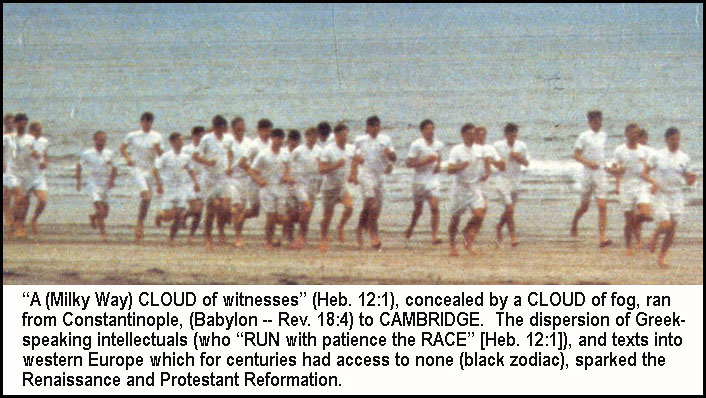
A closed book is not understood (Isa. 29:11-12; Dan. 12:4). Papal Rome achieved this by keeping the Bible in Latin which few could read and hidden away in monasteries where few visited. Permission was required to even read it. But Catholic armies were too busy fighting the Turks to persecute Protestants; and Greek scholars fled west with their manuscripts and knowledge which they taught. Orion's eastern foot was flooded by the expanding Euphrates (Turks). They escaped to the foot on dry land in the western Roman Empire (see Daniel 2:33,41), thus preserving the Greek manuscripts and opening them up to people's understanding (10:2) just when Gutenberg invented movable type and printed the first Bible on vellum (animal hyde) in 1455. The scholars kept quiet, only spreading their manuscripts among other learned men in the colleges and universities and this began the Renaissance or Rebirth of Learning. The result was a revival in the study of the classical languages, Greek being taught in Europe for the first time in 1458 A.D. By 1483, in only 30 degrees of time (30 years -- the width of each constellation), Caxton published the earliest verses of the Bible to be printed in English.
"And cried with a loud (red radius line) voice, as when a lion roareth (Orion holding lion's head): and when he had cried, seven thunders (Scorpio tail) uttered their (red radius line) voices. And when the seven thunders had uttered their voices, I was about to write: and I heard a voice from heaven saying unto me, (Full moon) Seal up those things which the seven thunders uttered, and (red radius pen) write them not" (10:3-4).
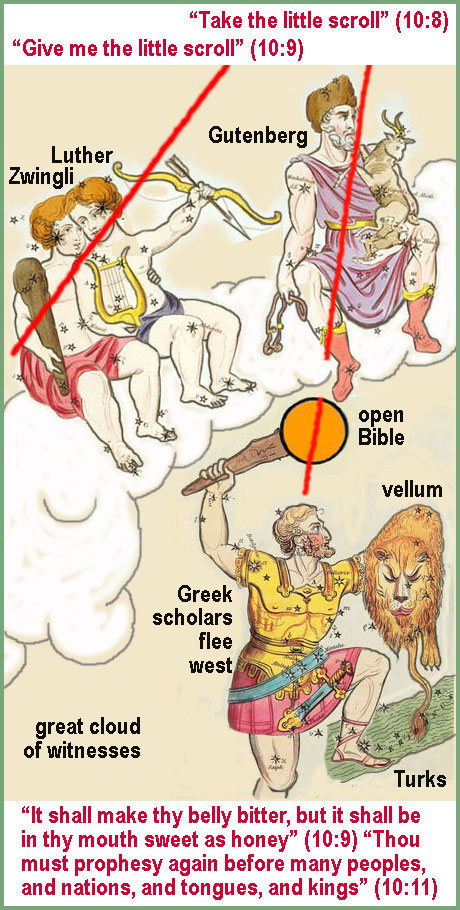
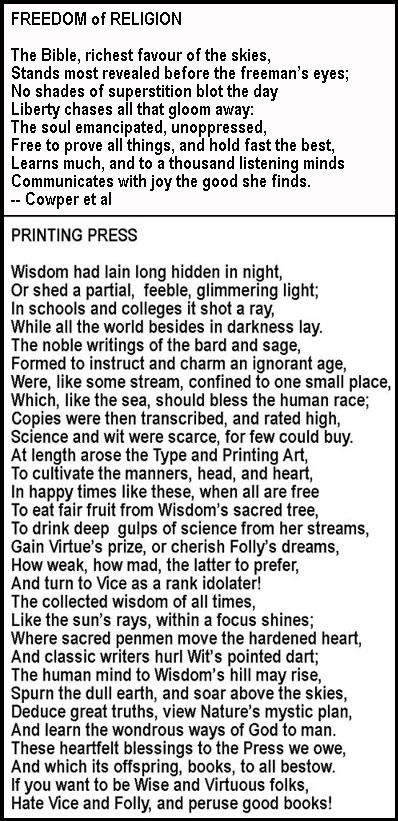
Astronomically, Orion's open SUN book is so powerful it is like a roaring lion which Orion is holding in his other hand. Historically, Revelation 10:3 has the "Angel" crying "with a loud voice, as when a lion roareth" which pictures the Lion of the tribe of Judah shouting through the pages of Scripture to the Church of Rome through the writing and preaching of Reformation leaders such as Luther, Zwingli, Calvin and Knox. Historians often refer to Papal Edicts and Bulls as the "thunders" from the seven-hilled city of Rome. Therefore we read that "seven thunders uttered their voices" (10:3) in reply. Gibbon uses the word and says "The spiritual thunders of the Vatican depend on the force of opinion; if that opinion be supplanted by reason, the sound may idly waste itself in the air" (ch. 70). Luther said, "Terrible as the lightning and the thunder, fulminatory Bulls and anathemas impended over the heads of those who incurred pontifical displeasure" (Antichrist Revealed, p.47). John was told to "write them not" (10:4) because he was only to "write ... true and faithful" words (Rev. 21:5). Similarly, Luther replied to the Pope's final Bull thundered in June 1520, by gathering an audience outside the walls of Wittenberg where he deliberately burned the Papal Bull and Edicts. In this manner the "seven thunders" were "sealed up" (10:4) which is portrayed astronomically by a full moon SEAL pushed onto Scorpio's SEVEN-segmented, poisonous stinger -- 1 Cor. 15:56. (1633 A.D. -- 180 degree-years from Orion) The full moon censors libel and blasphemy ("the sting of death is sin" -- 1 Cor. 15:56) while the sun radiates truth. What happened on this lunar date? What was the pope's libel? There are actually three dates -- using 180 degrees first as days -- 1453, then months -- 1468, then years -- 1633.
From May 26th, 1453 A.D. (Orion -- "mighty angel ... his face as ...the SUN" -- Rev. 10:1) we add 180° DAYS to arrive at November 22, 1453. Pope Nicholas V called for a crusade against the Turk on Sept. 29, 1453. But his call went UNHEEDED. He ordered a fleet to aid the beleagered city, but it arrived TOO LATE. Genoa and Venice even solicited FRIENDSHIP with the Turk. In other words, the FULL MOON had been pushed onto his stinger -- neutralizing it.
If we add 180° MONTHS, we arrive at 1468. There was a plot against the Pope's life on February 1468 by immoral, free-thinkers of the Roman Academy called Academicians. In the middle of March, 1468, all the teachers in Rome were, on account of the danger of heresy, forbidden to make use of the old Classical poets. According to Platina, the Academicians were ACQUITTED from the charge of actual heresy. Accordingly, the prisoners were now NO LONGER SHUT UP, but merely detained in the Papal Palace, then within the precincts of the Vatican, and finally, at the intercession of some of the Cardinals, especially Bessarion, only in the City of Rome; but the Academy was dissolved, and certain limitations were imposed upon Classical studies. "If God preserves my life," said the Pope to one of the Ambassadors very soon after the discovery of the plot, "I will do two things; in the first place, I will forbid the study of these senseless histories and poems, which are full of heresies and blasphemies (Juvenal, Terence, Plautus, and Ovid), and, secondly, I will prohibit the teaching and practice of Astrology, since so many errors arise thence." But the FULL MOON had been pushed onto his stinger.
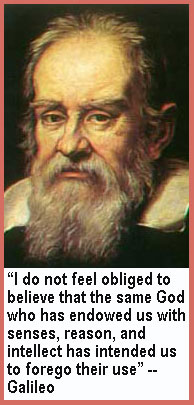
If we add 180° YEARS, we arrive at 1633 when Papal bulls and edicts were "thundered" from the seven-hilled city of Rome (seven-segmented Scorpio stinger -- 1 Cor. 15:56) to condemn Galileo for believing in HELIOCENTRISM. The Papal condemnation of Galileo for "having believed and held the doctrine, which is false and contrary to the sacred and divine Scriptures, that the Sun is the center of the world and does not move from east to west and that the Earth moves and is not the center of the world" -- June 22, 1633 -- required him to recant by swearing an oath. Is the earth stationary and do the sun, moon, and planets revolve around it perhaps once per day (cp. Ps. 93:1, 96:10, 104:5, 1 Chr. 16:30 and Eccl. 1:5)? Galileo believed that the earth was ROTATING which can be proven with Foucault's PENDULUM (Scorpio and the FULL MOON plumb bob suspended from Scorpio's stinger with red radius line string) swinging in a constant plane of oscillation (Milky Way path) from one side (the lunar extreme) to the other (the solar extreme) yet appearing to travel in a full circle (Zodiac) in 24 hours at the poles and 48 hours at 30 degrees latitude. Once again, the FULL MOON NEUTRALIZES Scorpio's stinger using it as a pendulum. "SEAL up those things which the seven thunders uttered" (red lines represent speech) (10:4). To prove that the earth REVOLVES around the SUN, simply observe the same section of sky six months apart (SUN and MOON positions 180° apart) with a telescope and the stars (black zodiac) will seem to shift positions due to PARALLAX. Also RETROGRADE MOTION of planets is most easily explained by HELIOCENTRIC model.
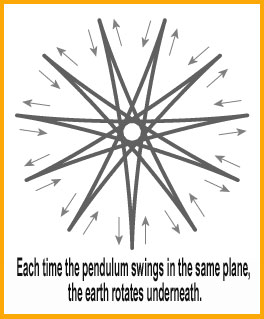
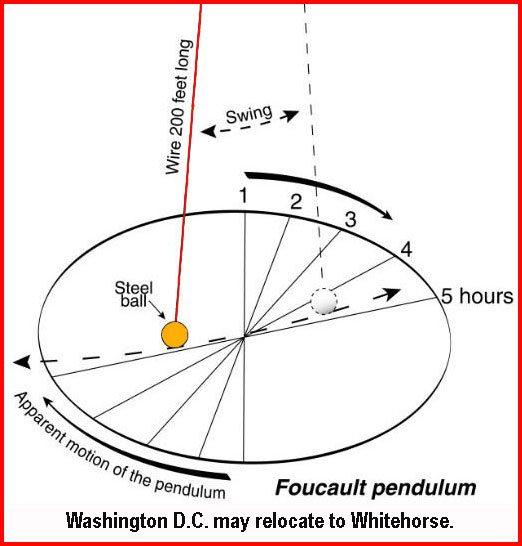
"And the angel which I saw stand upon the sea and upon the earth lifted up his hand to heaven (Orion), And sware by him that liveth for ever and ever (Cepheus), who created heaven, and the things that therein are, and the earth, and the things that therein are, and the sea, and the things which are therein, that there should be time (360°) no longer: But in the days of the voice of the seventh angel, when he shall begin to sound, the mystery of God should be finished, as he hath declared to his servants the prophets" (10:5-7).
Orion "swore" to "delay no longer" in revealing the Scriptures to mankind (10:6-7). The stars in Orion's belt may be Caxton, Erasmus, Zwingli and Gutenberg as well as unnamed RUNNERS who escaped Constantinople. Recall that Elijah was such a fast marathon RUNNER that he beat Ahab's chariot from Mt. Carmel to Jezreel -- 23 miles away. Each of these "Elijahs" may be like a "chariot of fire" (2 Ki. 2:11-12) since the SUN forms the fiery WHEEL of Auriga's chariot (and MOON WHEEL at other end of Milky Way AXEL) at the same time it is a Greek Orthodox OLYMPIC TORCH. "For behold, the Eternal will come with fire, and with his chariots like the whirlwind, to render his anger with fury, and his rebuke with flames of fire" (Isa. 66:15) -- Auriga with the star Capella -- the charioteer with his chariot superimposed. Anciently, Leo, Ursa Major and Ursa Minor were all given the chariot symbol as well. The stephanos (sun CROWN made of leaves or gold) was given to victors in the GREEK GAMES. The same word is used of the CROWN of life (James 1:12; 2 Tim. 4:8) and CROWN of thorns (Matt. 27:29). Astronomically, Orion's hand is lifted up to heaven as it holds an open scroll. Historically, "There should be TIME no longer" (Rev. 10:6) refers to the fact that a "TIME" is 360 years and that the last one is the "TIME of the End" (Dan.9:35; 12:4) from 1557 to 1917. The accession of Queen Elizabeth and the permanent establishment of the Protestant Church in England began in 1558. This was the seventh or last TIME of the Gentiles as the Angel said. On December 9th 1917, (during the Festival of Hanukkah) British General Allenby liberated Jerusalem from the Turks. Or alternately, January 15th 1559, Queen Elizabeth was crowned. If we add 365 years to 1559 we arrive at 1924 when the Turkish Caliphate was abolished. Furthermore, from 586 b.c. till 1935 a.d. is "seven times" so 1575 is significant in this context. Also 597 b.c. till 1924 a.d. so 1564 a.d. is significant.
"And the (red radius line) voice which I heard from heaven spake unto me again, and said, Go (Pollux) and take the little (golden sun) book which is open (divided by the red radius book mark) in the hand of the angel which standeth upon the sea and upon the earth (Orion). And I went unto the angel, and said unto him, Give me the little book. And he said unto me, Take it, and eat it up; and it shall make thy belly bitter (persecution), but it shall be in thy mouth sweet as honey (righteousness generates happiness). And I took the little book out of the angel's hand, and ate it up (sun travels 30°) ; and it was in my mouth sweet as honey: and as soon as I had eaten it, my belly was bitter" (10:8-10).
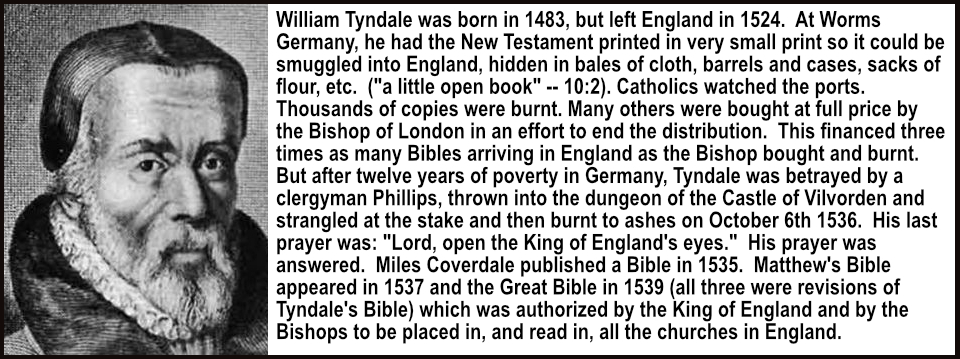
Then John ate the little book. Notice that the star chart portrays a "Torah scroll" torch first in the hand of Orion held high (ch. 10) and then in the hand of Pollux (Gemini) near his mouth (ch. 11). More importantly, a golden solar book is open with red radius bookmark over Orion. It moves to Pollux. "The law of the Lord is ... SWEETER also than HONEY" (Ps. 19:7-10). "O how SWEET are thy words unto my throat! Yea, SWEETER than HONEY unto my mouth" (Ps. 119:103). Historians record that in the Reformation the Bible became the most treasured thing in all the world, diligently read by millions, carried about in the bosom, studied and committed to memory, so SWEET was its heavenly manna to men and women hungry for spiritual guidance. However, along with more knowledge comes more responsibility. After studying and digesting the message of the Bible, Protestants now had to obey it (Jer. 15:16; Ps. 119:103). Roman Catholic doctrine had to be condemned and abandoned. Obedience to the Bible brought "BITTER" persecution from Rome. During the 30 years after Luther's protest, all Europe experienced the Inquisition which condemned multitudes of true Christians to BITTER torture and death because they studied the Scriptures. In England, when Tyndale was executed October 6th, 1536, his last words were, "Lord, open the King of England's eyes." Within less than a year, a royal decree ordered a copy of the whole Bible placed in every parish church. By 1540 this order became a reality. Henry VIII and Edward VI both placed Bibles in all churches with the injunction that it be read and taught. Then came Roman Catholic Mary's reign when nearly 300 Protestants, including Latimer, Ridley and Cranmer, were burned alive. During those same years, from 1st October, 1553 to 17th November 1558, on the Continent tens of thousands of Protestants were BITTERLY imprisoned, tortured, buried or burned alive, crucified on trees and badly treated -- merely because they possessed Bibles and had tasted its SWEETNESS. This will occur again in America before our Lord returns since "they are a rebellious house" (LXX "EMBITTERED house" -- Ez. 3:9,26,27). That is why we read in Luke 18:8, "Nevertheless when the Son of man cometh (in 2026), shall he find the Faith (Bible followers) on the earth?" Ezekiel also ate a scroll that was "as honey for SWEETNESS" (2:8-10), but then he experienced the "BITTERNESS and hot anger" (3:14). As Queen Elizabeth passed under a triumphal arch erected in Cheapside a Bible was let down into her hands by a white-robed child called "Truth." The queen received it, kissed it and pressed it to her heart, replying that this present was more acceptable to her than any of the more costly ones the city had given her that day of her accession (Walter's History of England).
"And he said unto me, Thou must prophesy again before many peoples, and nations, and tongues, and kings" (10:11).
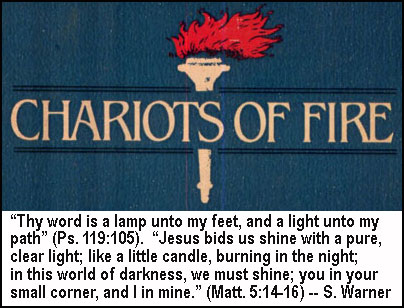
John wrote the Revelation once in his own life while imprisoned on Patmos. The Reformers preached from it "AGAIN" because Revelation was a very popular book. Then Orion passed off the TORCH to John who became Pollux (4:1; 11:1) who took the "law of the Lord (which) is ... sweeter also than honey" (Ps. 19:7-10) and digested (understood) the Bible and this brought "bitter" persecution when the Bible was obeyed (10:10) (The movie "Chariots of Fire" seems to dovetail into the chronology of Rev. 10). Just as the sun in Orion is positioned JUST BEFORE the summer solstice when the longest, brightest, and hottest days occur, so also the events of these 30 years were a time of bright illumination and hot, zealous progress for Christianity which added WINGS to their heels (Perseus). Preserving and distributing the Greek manuscripts (Orion) came JUST BEFORE both the Renaissance and Protestant Reformation (summer solstice; Leo).
Just as Greek scholars fled Constantinople in 1453 and ran in a Milky Way cloud toward a WHITE HORSE Inn at Cambridge (white lunar dot) identified by the "sign" of Sagittarius pointing to it, where Tyndale held his meetings, so also this Zodiac may be a map of where Christians must flee in the future. Dots on maps are towns. If Washington D.C. (paralleling Constantinople) is set aflame (yellow dot on Zodiac map) and eastern United States (paralleling Eastern Europe) is invaded by Islam, then Christians must escape by travelling up the Al-Can Highway (Milky Way) through British Columbia (a type of Britain) to WHITEHORSE Yukon. The race must come at a time when PRESERVING Christian truth is paramount, paralleling Elijah's work (Mal.4:5-6) of restoring "all things" (Matt. 17:11-- spiritual education) necessary for the Millenium Renaissance and a new "Protestant Reformation" led by our Lord Yeshua (paralleling Martin Luther and King Henry VIII). This may involve PRESERVING many web sites and books -- the best in American Christian society. They meet together with our Lord Yeshua (paralleling Tyndale) in a resurrection (rapture) and start a new Reformation and a new Renaissance. These are the Bible followers who will mount up onto WHITE HORSES (Rev. 19) as part of Christ's returning cavalry. They obey our Lord and "flee Babylon" (U.S.). Does this symbolism also teach continuity of government for the U.S. in Whitehorse? We will wait and see. "The thing that hath been, it is that which shall be; and that which is done, is that which shall be done" (Eccl. 1:9). God says, "I change not" (Mal. 3:6). He is "the same yesterday, today and forever" (Heb. 13:8).