.jpg) 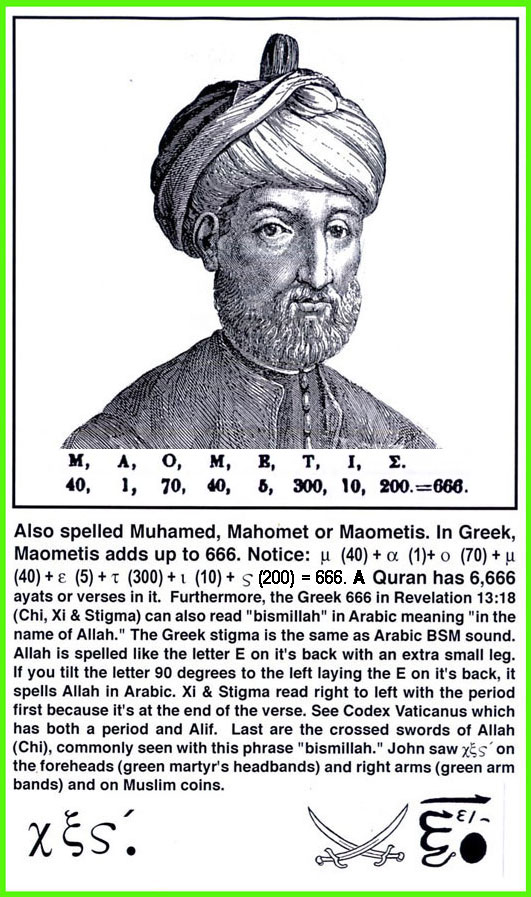
Arabs In Prophecy
Is Allah a moon-god (Her. 1:131)? Is that why the symbol of Islam is a crescent moon? Was Mohammed demon-possessed? Do Moslems deny that Jesus is the son of God? Isn't it idolatrous to kiss and pray toward the black Kaaba stone? Is the Koran inspired? What does the Bible say about Arabs and Islam? How do these "locusts" hurt men for "five months" (Rev. 9:3-5)? Does the Bible mention Mohammed? Did the angel Gabriel really speak to him? Who was Sergius?
This article is written using the historicist interpretation of prophecy.
Who Is Allah? The MOON god was called "Allah" in pre-Islamic times and "Lucifer" (Hebrew "Hillel" -- Isa. 14:12) means "Crescent Moon" ("Hilal") in Arabic -- The "Great DECEIVER" (Koran 3:52) called SATAN the DEVIL (Rev. 12:9)
Evidence gathered from north and south Arabia demonstrates that MOON-god worship was active in Muhammed's day and was the dominant cult. According to numerous inscriptions, while his name was "Sin," his title was "Alilah" or "the Deity." As Calton S. Coon pointed out, "The god Ilah was originally a phase of the MOON god." The MOON god was called "Alilah" (i.e. the god) which was shortened to Allah in pre-Islamic times. The pagan Arabs even used "Allah" in the names they gave their children. For example, both Muhammed's father (Abd-Allah) and uncle (Obied-Allah) had Allah as part of their names. This MOON-god Allah was morphed into the "Supreme Being." This is why Allah is never defined in the Koran. Arabs already knew who he was -- the supreme pagan MOON god in a pantheon of deities. This is why the Muslim creed is not "Allah is great" but "Allah is greatest" (of the pantheon). This is why the symbol of Islam is the CRESCENT MOON. This is why a CRESCENT MOON sits on top of their mosques and minnarets and is on flags of Islamic nations. This is why Muslims fast only during the month which begins and ends with the appearance of the CRESCENT MOON. The pagan Arabs worshipped the MOON god Allah by praying toward Mecca several times a day; making a pilgrimage to Mecca; running around the temple of the MOON god called the Kaabah (the local shrine which housed numerous pagan idols); kissing the black meteorite stone; fasting in the LUNAR month of Ramadan, etcetera.
Since Moslems worship their god the same way today, their god must be the same MOON god of the Sabeans-- not the Supreme God that Jews and Christians worship. But this fact is disguised by Surah 41:37 which says "Do not prostrate to Moon or Sun" and "The moon is subject to his command" (Surah 16:12). Another proof that Moslems worship the MOON god is the "Satanic verses" in the Koran (Surah 53:19-20) where Mohammed approved of the worship of three goddesses, the daughters of Allah. These were the same three daughters of the MOON god -- al-Uzza (Venus), al-Lat (crescent) and Manat (fate). The Allah of the Koran is the MOON god that Moslems unknowingly worship. Someone will argue that the "El, Eloi and Elohim" (God) of the Bible is the same as "Allah" (god) of the Koran because of the almost identical spelling and sound of the Hebrew, Aramaic and Arabic. But Ilah is the name for god, not Allah, in Arabic. For instance, Surah 4:171 says, "Allah is only one Ilah (god)." Furthermore, unlike Allah, the God of the Bible has a Son, and does not wish to exterminate Jews and Christians and ban the Bible. The God of the Bible has no history of being worshipped as a MOON-god. Instead, Isaiah 14:12 mentions "Lucifer" which in Hebrew is "Hilal" which means "Crescent Moon" in Arabic. Thus Satan is symbolized by a Crescent or Morning Star. God is all-knowing, unchangeable, and perfect, but Allah makes corrections in his Koran. Later passages nullify earlier ones (Sura 2:106). Allah lies in wait to kill non-Muslims (Quran 9:5). Satan masquerades as an angel of light (Gal. 1:8-9; 2 Cor. 11:14). According to Koran 4:157, Allah made it appear to people as if Jesus (Isa) had been crucified, but they did not actually kill or crucify him; instead, someone resembling Jesus died in his place, and Jesus was raised to heaven alive. Yes, "Allah leads astray whomsoever he will, and he guides whomsoever he will" (Koran 14:4).
Among the 99 names of Allah are "Most Proud One"(Isa. 14:13-14), "Afflicter," "The One Who Causes Death" (Destroyer) (Rev. 9:11), "Great DECEIVER" (Quran 3:52; Rev. 12:9) and "Great Plotter." The Hebrew word for "curse" is "ALAH" (# 423 of Strong's) (see Dan. 9:11) and the serpent was cursed in Genesis 3:14. The name "Allah" can be broken down into the Hebrew "Al" meaning "No" (#408) and "lah" meaning "Law" (#3809) or "No Law" -- the man of lawlessness (2 Thess. 2:3-4). "The most awful name in Allah's sight on the Day of the Resurrection will be that of a man calling himself the King of Kings" (Sahih al-Bukhari 73:224). Why? Because Christ, the King of Kings (Rev. 19:16), will cause Satan (Allah) to be cast into hell (Rev. 20:10).
A leading Islamic scholar, Fred McGraw Donner, says, "The Kaaba ... was the sanctuary of the pagan god Hubal". Another pro-Islamic writer, Karen Armstrong, agrees. She says the pagans before Mohammed used to kiss the black stone meteorite in the Kaaba. She says "officially the Kaaba shrine was dedicated to Hubal, a Nabatean deity." Hubal is the name for BAAL (Hubal = Hebrew Ha Baal or "THE BAAL"). Yet Hubal must also be Allah since the same shrine can't honor two different gods. Islam is therefore BAAL worship. F. E. Peters, a Muslim historian, in his book Hajj, says, "Amr ibn Luhayy brought with him to Mecca an idol called Hubal from the land of Hitt in Mesopotamia. The pagans would circumambulate the Kaaba and shave their heads in honor of Hubal before the time of Mohammed. Now Ibn Kathir's Biography of Mohammed vol. 1, pp. 125-126 says, "Abd al Muttalib promised that if Allah would give him 10 sons he would sacrifice one of them (a human sacrifice) to Allah". BAAL demanded human sacrifice. But after consulting a witch and using divining arrows, he was able to substitute ten camels as a ransom for Abdullah his son when the arrows were cast and pointed to the camels rather than the son at the shrine of his god Hubal which was the Kaaba. Therefore Hubal is Allah who is BAAL. In the New Testament, BAALzebub (Mark 3:22-30)("Baal Lord of the House") is the prince of demons (SATAN). Therefore, Hubal = Allah = Baal = SATAN. Alat is the Arabicized word for Ishtar. Jihad (killing infidels) is human sacrifice to Allah (BAAL). Abdullah Yusuf Ali in his translation of the Koran mentions that the Arabs in Mecca before Muhammed worshipped the sun, moon and five planets as seven gods and goddesses. The moon was the male deity and the sun female. The Kaaba in Meccah was a shrine that housed 360 idols. Pagans would run around the Kaaba seven times just as Muslims do today in honor of the seven planetary deities. Ishmael settled in Paran near Egypt (Gen. 21:21) and was never in Meccah to teach this nonsense. From the book Gods, Goddesses and Mythology, vol. 11, p. 137: "Hubal, chief god of the Kaaba, a martial and oracular deity, a moon god." From the New Encyclopedia of Islam by Siroglase, p.209, "Hubal, an idol, the god of the moon. Centuries before Islam, Amr ibn Luhayy, a chief of the tribe of Jorhum, before the coming of the Quraysh tribe, brought the idol from Syria to the city of Meccah. It was set up in the Kaaba and became the principal idol for the pagan Meccans." The chief god in Syria among the pagans was BAAL. Muhammed was born into the Quraysh tribe of Meccah, born into BAAL worship.
Who Was Mohammed? -- "Lost" (Koran 93:7) and "In Open Error" (Koran 34:24) -- But Somehow "An Excellent Example" for Muslims (Koran 33:21)
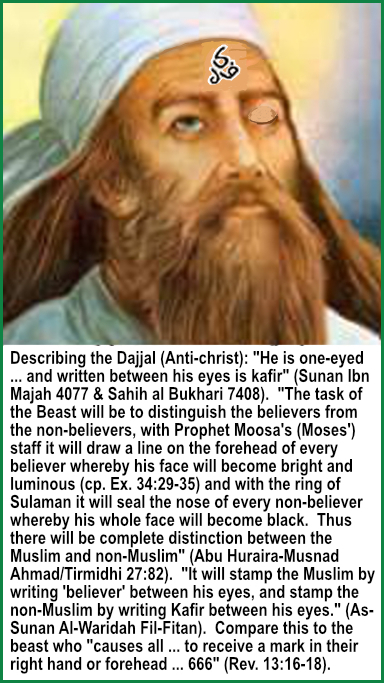
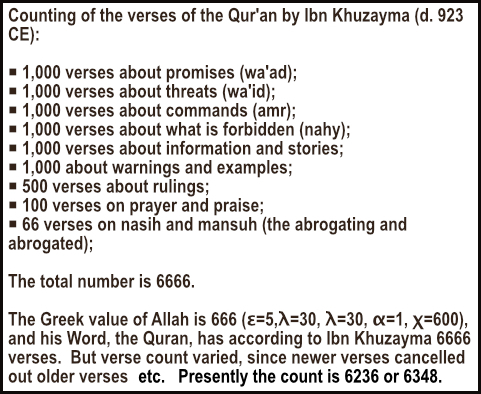
Mohammed was a descendant of Ishmael through his son Kedar according to Muslim tradition. Mohammed's father died soon after he was born and his mother died at age six so he was taken care of by his uncle. At age 25 he married a rich widow, 15 years his senior. She bore him six children. All died at a young age except Fatimah his daughter. Mohammed was also a SINNER. In Surah 18:110 Allah commanded Mohammed, "Say I am but a man like yourselves." In Surah 40:55. Allah says to Mohammed, "Ask forgiveness of thy SIN." In Sura 48:1-2 they said to Mohammed, "Allah may forgive thee of PAST and that which is TO COME." For instance, Surah 4:3 says a Muslim can only have four wives but Muhammed had over 30 sex slaves and 16 wives (Koran 4:3, 24; 5:89; 23:5; 33:50; 58:3; 70:30). Muhammed was therefore an ADULTERER and RAPIST (This is why "rape" is not mentioned in the Koran). Mohammed endorsed and participated in SEX SLAVERY (Koran 23:6; 1:21; Sunan Abi Dawud 2155). He married his wife Aisha when she was six years old and consummated the relationship when she was only nine years old (Bukhari 7:62:88; Sahih Muslim 1122). PEDOPHILIA. Mohammed was 54 years old at the time and was married to another wife Sawda bint Zama (Sahih Bukhari 7:62:64). Mohammed LUSTED after Zainab, the wife of his adopted son. But when his adopted son offered her to him, he refused saying "Keep thy wife to thyself and fear Allah." Mohammed thus hid his desire (Koran 33:37). Then Mohammed conveniently received a "vision" commanding him to take Zainab in marriage. This enraged the Madinans. Mohammed's defense was "Allah ordered me to acquire Zainab." As Aisha said, "I feel that your Lord hastens in fulfilling your wishes and desires" (Sahih Bukhari 6:60:311; Sahih Muslim 8:3453). Mohammed would CROSS-DRESS in little girls' underwear (Sahih al-Bukhari 2581) and he sucked on little boys' tongues (Al adab Al Mufrad 1183; Musnad Ahmad 16213). PEDOPHILIA. He was constantly covered in SEMEN (Sahih al-Bukhari 229, 230 & Sahih Muslim 669). According to the Musnad of Ibn Hanbal, narrated by Abdullah ibn Masud, the Al-Zutt "rode" or "mounted" Mohammed and "They wounded me all night long". This sounds like SODOMY or HOMOSEXUALITY. Furthermore, he was a THIEF because he robbed caravans -- on Ramadan no less! (Ibn Hisham pp.281-). Mohammed received 20% of all this stolen property (Koran 8:41). He killed an estimated 3000 people, including beheading 700 Jews of the Banu Qurayza tribe in Medina in 627 A.D. (Sahih Bukhari 1037; Sahih Muslim 18010) Mohammed also ordered the death of anyone who criticized him (Siral Rasul Allah pp. 515, 675, 676, 671). He was therefore a MURDERER of people who were more righteous than himself. Surah 93:7 says Mohammed was "lost" (criminal; sinning; idol-worshipper; error-prone; see also Quran 47:21). When his followers are called "Mohammed bin Muhomed al-Mahomet" today, what can we expect from them, but to imitate their namesake? Mohammed taught his followers to drink CAMEL'S URINE (Bukhari 5686), yet admitted that "Camels were created from DEVILS" (bnmajah 769). Mohammed was an IDOLATER (Sahih Bukhari vol.6 p.452). He praised three pagan goddesses (Al-Lat, Al-Uzza & Manat) (POLYTHEISM) and then explained that "SATAN had put them on his tongue" (Koran 22:52). He could not perform miracles (Quran 29:49). Yet he ordered his followers to PRAY TO HIM (Hadith of the Blind Man; Hadith of the Man in Need). Mohammed first thought his revelations were inspired by SATAN. In fact, he attempted SUICIDE several times because he thought he was inspired by SATAN (Sahih al-Bukhari 6982).Thus by claiming to be a prophet, he became a LIAR. He even advocated LYING (Taqiyya). The "angel Gabriel" tried to choke Mohammed three times till exhaustion in a cave. We believe this was SATAN who "disguises himself as an angel of light" (2 Cor. 11:14). Mohammed had revelations accompanied by "epileptic fits." Therefore he was DEMON-POSSESSED (not epileptic). One of the Quraish women said of Jibril, "His SATAN has deserted him" (Bukhari 2:225). The Koran even teaches that the DEVIL spoke to Mohammed (Koran 17:73-75; 22:52-53; 53:19-26). "How does the divine inspiration come to you?" He replied, "The Angel sometimes comes to me with a voice which resembles the sound of a ringing BELL" (Sahih al-Bukhari 3215). Yet "the BELL is the musical instrument of SATAN" (Muslim 2114). Aisha narrated, "Once the Prophet was BEWITCHED so that he began to imagine that he had done a thing which in fact he had not done." (Sahih al-Bukhari 3175) He was a victim of a magic spell (Bukhari 5765). "The Prophet took me with him to a high hill in Makkah. He drew a circle with his foot for me and advised me to keep sitting within that circle. Seating Hadhrat Abdullah ibn Masood within that circle, he advanced ahead and then stood at a place. There, he started recitation of the Holy Quran. All of a sudden a big group of jinns (DEMONS) encircled the Prophet". "If there arise among you a prophet (Mohammed), or a dreamer of dreams ... saying, Let us go after other gods, which thou hast not known (Allah), and let us serve them, Thou shalt not hearken unto the words of that prophet ... Ye shall walk after the Eternal your God, and fear him, and keep his commandments, and obey his voice" (Deut. 13:1-4). "Though we, or an angel from heaven ("Gabriel"), preach any other gospel unto you than that which we have preached unto you, let him be ACCURSED" (Gal. 1:8). The Hebrew word for "CURSE" is "ALAH" (# 423 of Strong's) (see Dan. 9:11) and the serpent was CURSED in Genesis 3:14. "If Mohammed had made up about us some false sayings, we would have seized him by the right hand, then SEVERED his AORTA" (Koran 69:44-46). As if to confirm their suspicions, when Mohammed was dying, he actually said, "I feel as if my AORTA is being CUT" (Sahih al-Bukhari 4428) indicating he was a FALSE PROPHET.
Why Kiss and Pray Toward the Black Kaaba Stone?
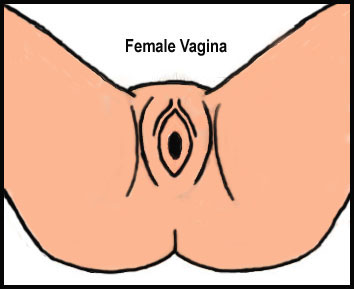
In pre-Islamic times the Quraish tribe from which Mohammed descended were accustomed to circle the Kaaba and say "On Al-lat, Al-Uzza and Manat, the third and the others ... on their intercession of Allah may you hope." These three goddesses were mediators between the humans and the MOON-god Allah. Acts 19:35 mentions that Diana, the MOON goddess, was worshipped using an image which "fell from" heaven. "Arabians called Aphrodite Alilat" (Herodotus 1:131). The black stone in a metal framework was shaped like a VAGINA -- their "Creator." Arab men and women used to walk around the Kaaba totally NAKED (Quran 7:31) and then KISSED this vagina rock that fell from heaven to suck their sins (SPERM) away. The pointed oval was a worldwide symbol of the great "Mother Goddess" because it represented the external genitalia of the female -- her VULVA. The rock was supposedly originally white (Lucifer was originally righteous) but turned black by taking people's sins. In plain language, it was a sacred house of PROSTITUTION. At first Mohammed prayed in any direction (Surah 2:115). But later he taught Moslems to pray to Mecca and make a pilgrimage to Mecca in order to generate money. It was a business (see Surah 2:199). Hadith Sahih Bukhari #6819 under chapter heading "Forbidding What the Prophet Never Forbade" we read that Mohammed never forbade having SEX with the NAKED women while they were walking around the Kaaba at the time of the Hajj (pilgrimage). How shameful. Satan is this star (black meteorite) that fell from heaven (Isa. 14:12-15; Luke 10:18; Acts 9 &19:23-41). One quarter of humanity prays toward this meteorite (star) and kisses it. This is idol worship and Satan worship. This Beit-Allah of Mecca counterfeits Jacob's Bethel Stone (Gen. 28:18-19).
No Regard For the Desire of Women (Dan. 11:37)
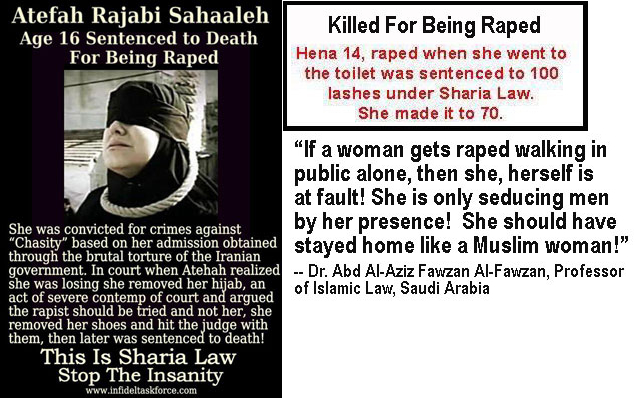
"Tell believing women to lower their gaze" (Quran 24:31). A Muslim woman cannot raise her face to the level of a man. A Muslim woman cannot wear garments that expose any part of her anatomy other than her eyes (Burqa). Women hate the Hijab. "And have two men act as witnesses; but if two men are not available, then a man and two women you approve, so that in case one of them is confused, the other may prompt her" (Quran 2:282). "Is not the evidence of two women equal to the witness of one man? They replied in the affirmative" (vol.1, book 6, No. 301; narrated by Abu Said Al-Khudr). Therefore, in Muslim lands governed by Sharia, it is virtually impossible for a woman to prove she has been raped without the eyewitness testimony of another person. This is because it takes the evidence of two women to equal the testimony of one man. Furthermore, when the woman admits that she has been sexually violated, she places herself at risk of being charged with premarital sex. According to one report, as many as 75% of the women in prison in Pakistan are there because of the "crime" of being raped. An added danger to a Muslim woman who has been raped is the risk of being killed by a family member who wishes to remove the stain on the family's honor. It's called "honor killing." It can be carried out by a father or brother of the woman for merely speaking to an unrelated man or a mere rumor of a loss of virginity. Or for wearing make-up or talking to a stranger. "Female Genital Mutilation" is also practiced in Moslem countries to reduce the woman's sexual desire and thus protect her virginity. What is the punishment for adultery? Flogging with 100 stripes for men and women (Surah 24:2) and then women are confined to their houses till death claims them (Surah 4:15) but men, if they repent and amend, leave them alone (Surah 4:16). Muslim husbands are given permission to beat their wives when the wife is disobedient. "Men are in charge of women, because Allah hath made the one of them to excel the other, and because they spend of their property (for the support of women). So good women are the obedient, guarding in secret that which Allah hath guarded. As for those from whom you fear rebellion, admonish them and banish them to beds apart, and scourge them" (Quran 4:34). The definition of "Disobedience" is "to leave the house without the husband's permission, to refuse to obey the husband in bed (husband is allowed to rape wife), to speak to the husband impolitely, or to do the opposite of what he likes. All these are forms of disobedience" -- Egyptian cleric Galal Al-Khatib December 24, 2008. "Women are like fields for you, so seed them when you like" (Quran 2:223). A Muslim husband is allowed to marry four wives, and have sex with slave girls (captives from a jihad -- Zech. 14:2) (Quran 4:3). Women are seen as pieces of property to be owned and sold. Regarding inheritance: "Allah thus directs you as regards your children's (inheritance): to the male, a portion equal to that of two females" (Quran 4:11).
   
The Koran Gives Authority To The Bible -- "Ask Those Who Have Been Reading the Scripture Before You" (Koran 10:94) And "We Believe In What Has Been Revealed ... to You" (Koran 29:46) And "Do you believe in some of the Scripture and reject the rest? Is there any reward for those who do so among you other than disgrace in this worldly life and being subjected to the harshest punishment on the Day of Judgment?" (Koran 2:85)
Consider the following Suras: Sura Baqara 2:136 points out that there is no difference between the scriptures which preceded and those of the Qur’an, saying, “…the revelation given to us…and Jesus…we make no difference between one and another of them.” Sura Al-I-Imran 3:2-3 continues, “Allah…He sent down the Law (of Moses) and the Gospel (of Jesus)…as a guide to mankind.” Sura Nisaa 4:136 carries this farther by admonishing the Muslims to, “…Believe…and the scripture which He sent before him.” In Sura Ma-ida 5:47,49,50,52 we find a direct call to Christians to believe in their scriptures: “…We sent Jesus, the son of Mary, confirming the Law that had come before him. We sent him the Gospel… Let the people of the Gospel judge by what Allah hath revealed therein, if any do fail to judge by the light of what Allah hath revealed, they are (no better than) those who rebel…” Again, in Sura Ma-ida 5:68 we find a similar call: “People of the Book!…Stand fast by the law, the Gospel, and all revelation that hath come to you from YOUR LORD. It is the revelation that has come to thee from THY LORD.”
To embolden this idea of the New and Old Testament’s authority we find in Sura 10:94 that Muslims are advised to confer with these scriptures if in doubt about their own, saying: “If thou wert in doubt as to what We have revealed unto thee, then ask those who have been reading the Book from before thee. The truth had indeed come to thee from thy Lord.” And as if to emphasize this point the advice is repeated in Sura 21:7, stating, “…the apostles We sent were but men, to whom We granted inspiration. If ye realize this not, Ask of those who possess the message.”
Finally, in Sura Ankabut 29:46 Muslims are asked not to question the authority of the scriptures of the Christians, saying, “And dispute ye not with the people of the book but say: We believe in the revelation which has come down to us and that which came down to you.”
If there is anything in these Suras which is clear, it is that the Qur’an emphatically endorses the Torah and the Gospel as authentic and authoritative revelations from God. Nowhere is there any warning in the Qur’an that the former scriptures had been corrupted, nor that they were contradictory. Codex Sinaticus was found in 325 AD and is very close to modern translations. The vulgate was finished in 414 AD by Jerome. Islam came afterward in 610 AD. so Mohammed gave his endorsement of Scripture that is uncorrupted.
Is the Koran Inspired? -- "Either We Or You Are Upon Guidance, Or in Open Error" (Koran 34:24)
"This [Islam] is nothing but a lie which he [Muhammad] has forged, and other have helped him do it... Fairy tales of the ancients, which he has caused to be written; and they are dictated before him morning and evening" (Surah 25:4-5) "O ye who believe! Ask not questions about things which if made plain to you, may cause you trouble. Some people before you did ask such questions, and on that account lost their faith" (Surah 5:101-102). "You shall not accept any information, Unless you verify it for yourself. I have given you the hearing, the eyesight, and the brain, And you are responsible for using them"- Quran 17:36 "Let there be no compulsion in religion; TRUTH stands out clear from error!"- Quran 2:256. There was no Arabic Bible till the 9th century A.D. so Mohammed's perceptions of Scriptural truths were garbled from hear-say. These perceptions were written on "parchments, scapula (bones), leafstalks of date palms and from the MEMORIES of MEN " and ANIMALS ATE SOME PARTS so they were LOST (Koran 19:44). What was left became the Koran. There are many internal contradictions necessitating the invalidation and abrogation of a number of verses. Later verses abrogate earlier verses when the two disagree (Koran 2:106). Even then the Koran is still a haphazard jumble of disjointed material, without order, continuity or unity of any kind. (Every version of the Koran also has a different numbering system.) This is why Moslems think the Bible has many errors in it -- because they read their garbled and confused Koran and then look at the Bible through those Koranic glasses.
First, Uthman bin Affan, third caliph after Mohammed, BURNED variant codices of the Koran. He had no authority to do that and didn't know what was in the Koran that Mohammed recited. Sahih al-Bukhari 4987 says, "differences in the recitation of the Koran" caused Uthman to order Zaid bin Thabet, etc. to "rewrite the manuscripts in perfect copies." Other copies were "BURNED". This is where the "Uthman Skeleton" came from. But Zaid bin Thabit is NOT among those who should be TRUSTED with the recitation of the Koran according to Mohammed himself. Notice as evidence Sahih al-Bukhari 4999: "I heard the prophet saying, 'Take (learn) the Koran from four: Abdullah bin Masud, Salim, Muadh and Ubayy bin Kab. So Mohammed's Koran was DIFFERENT from today's Koran standardized by Uthman and Zaid bin Thabit. As further evidence notice Sahih al-Bukhari 5005: "Ubayy was the best of us in the recitation (of the Koran) yet we LEAVE some of what he recites (meaning that some of what he recited is NOT in the Koran we have standardized). In Sahih al-Bukhari 5005, Ubayy says, "I have taken it from the mouth of Allah's messenger and I will not leave it for anything." Despite the fact that they do not have Ubayy's recitation as part of the standardized Koran, Umar ibn al-Khattab related that "Allah said 'None of our revelations do we abrogate or cause to be forgotten but we substitute something better or similar.' (Koran 2:106). But according to Jami at-Tirmidhi 3104:"Abdullah bin Masud disliked Zaid bin Thabit copying the written Koran (Musahif) and he said, 'O you Muslim people! I am REMOVED from recording the transcription of the the Mushaf (written Koran) and it is overseen by a man, by Allah, when I accepted Islam he was but in the loins of a disbelieving man (meaning Zaid bin Thabit) and it was regarding this that Abdullah bin Masud said: 'O people of Al-Iraq! Keep the Musahif (written Korans) that are with you, and CONCEAL them. For indeed Allah said: And whoever conceals something, he shall come with what he conceals on the Day of Judgment (3:161). so meet Allah with the Musahif (written Korans). Az-Zuhri said: "It was conveyed to me that some men amongst the most virtuous of the Companions of the Messenger of Allah disliked that view of Ibn Masud." Clearly there's a CONFLICT regarding which KORAN is correct. Al-Khattab, Uthman and Zaid bin Thabit on one side and Mohammed, Ubayy bin Kab and Abdullah bin Masud on the other. He was OVERLOOKED and his recitation LOST.
Second, we have LOST ENTIRE CHAPTERS of the Koran. The Koran we have today is not complete. Proof? Sahih Muslim 1050: "We used to recite a Surah which resembled in length and severity to (Sura) Bara'at. I have, however, FORGOTTEN it, with the exception of this
which I remember out of it: ... And we used to recite a Sura which resembled one of the Surahs of Musabbihat, and I have FORGOTTEN it, but remember (this much) out of it ..." More proof? Sunan ibn Majah 1944: "The verse of stoning and of breastfeeding an adult ten times was revealed, and the paper was with me under my pillow when the Messenger of Allah died, we were preoccupied with his death, and a tame sheep came in and ATE it." (Regarding adult breastfeeding see Sahih Muslim 1453 a,b,c,d). Now Mohammed's Koran had four approved reciters: 1. Abdullah bin Masud (112 chapters in his Koran) 2. Salim 3. Muadh 4. Ubayy bin Kab (116 chapters in his Koran). But today's Koran of Zaid bin Thabit (114 chapters in his Koran) which was standardized by Uthman is UNAPPROVED. (See Kitab al-Masahif by Abi Dawud as-Sijistani; also see Al-Burhan fi Ulum al-Quran by Badr Ad-din az-Zarkashi). Therefore, "Let none of you say, 'I have the whole Quran.' How does he know what all of it is? Much of the Quran has gone. Let him say instead, 'I have what has survived of it.' -- Abdullah ibn Umar ibn al-Khattab (appears in Al-Itqan fi Ulum al Quran by Jalal al-Din as-Suyuti). To say that what is lost is abrogated doesn't solve the problem. " "This is a topic that when you're the beginning, beginning student of knowledge, you're like, 'What is all of this going on here?' When you go a little bit more, you learn to simply memorize what your teachers say and regurgitate it out. and you don't fully comprehend. When you do a deep dive, is when things get very, very awkward and difficult." -- Yasir Qadhi (Islamic scholar) "And this isn't new. This is from the time of the Sahaba" (Mohammed's companions), "And the most advanced of our scholars, they're not quite fully certain how to solve all of the unanswered questions in them" (Quranic verses, etc.). -- Yasir Qadhi "These issues should only be discussed amongst people who know what the Qiraat are and who understand some of these questions that are being asked." (It is too embarrassing to let outsiders hear!) "Traditional understandings of Ahruf and Qiraat cannot answer some of these pressing questions that are now being poked ... by their academics outside of the Faith tradition." "You see, in a Muslim environment, there's always some respect that we have for the Koran. We should. In a Muslim environment, we'll press a little bit, and then we'll say, okay, Khalas, (that's enough). Samina wa atana (We listened and we obeyed.) And that's great, alhamdulillah (Praise be to God). When you go to academia, they don't have that red line. And they're going to just, you know, the famous story of the emperor with no clothes." "They're going to just point out, oh, that doesn't make any sense. Well, that's not true, and this and that. And they'll bring issues, which I'm not going to mention explicitly, that you know are true, because they're in your own books." "And its very clear to you, and to every single advanced student and specialist, that the standard narrative has holes in it." "These are now well known within the western academy ... Their level of knowledge is leaps and bounds above what it used to be, you know, a hundred years ago. What is happening in the last few years is not me anymore. It is Western academics. These problems are now becoming mainstream. And, by and large, our 'Ulama (scholars) in the eastern world are not aware, by and large, of what's going on in the Western side of things. And they're not answering those questions in a manner that it needs to be answered."
Third, Muslims argue, "We have the Birmingham Manuscript and other early codices proving that our Koran is what existed at the time of Mohammed." But when you look at these older codices, you see clear evidence of CORRECTIONS being made in manuscripts. Of overwriting, adjustments, changes, additions, subtractions, erasures, etc. Words are scraped off and rewritten. Letters are changed. Entire forms are normalized to match the official reading that came about later. That means that the foundation of the whole preservation narrative is FALSE. There was no fixed skeleton. Everything was EDITED after the fact. (See Daniel Alan Brubaker's book Corrections in Early Quran Manuscripts Twenty Examples). What would this need to be done to "God's Eternal Word"? Now, specifically, the Birmingham Koran only has three chapters (18, 19 & 20) of the Koran. Carbon dating the parchment itself places it to around the time of Mohammed. The ink and writing however were not. They came after the codification. So it doesn't fix the holes in the narrative.
Fourth, let's talk about Ahruf (modes) and Qira'at (readings): Sahih al-Bukhari 4991 says, "Gabriel recited the Quran to me in one way. Then I requested him (to read it in another way), and continued asking him to recite it in other ways, and he recited it in SEVERAL ways till he ultimately recited it in SEVEN DIFFERENT ways."
Another recitation is as follows: Sahih al-Bukhari 4991: (narrated by 'Umar bin Al-Khattab:) "I heard Hisham bin Hakim reciting Surat Al-Furqan during the lifetime of Allah's Messenger and I listened to his recitation and noticed that he recited in SEVERAL DIFFERENT ways which Allah's Messenger had not taught me. I was about to jump over him during his prayer, but I controlled my temper, and when he had completed his prayer, I put his upper garment around his neck and seized him by it and said, 'Who taught you this Sura which I heard you reciting?" (not just pronunciation differences apparently) He replied, "Allah's Messenger taught it to me." I said, "You have told a lie, for Allah's Messenger has taught it to me in a DIFFERENT way from yours." So I dragged him to Allah's Messenger and said, "I heard this person reciting Surat Al-Furqan in a way which you haven't taught me!" On that Allah's Apostle said, 'Release him (O Umar!), Recite, O Hisham!' Then he recited in the same way as I heard him reciting. Then Allah's Messenger said, "It was revealed in this way," and added, "Recite, O Umar!" I recited it as he had taught me. Allah's Messenger then said, "It was revealed in this way." This Quran has been revealed to be recited in SEVEN DIFFERENT ways, so recite of it whichever (way) is easier for you (or read as much of it as may be easy for you).
Fifth, the different Qira'at (readings we have today). They don't match the seven Ahruf because today we have TEN canonical readings, and FOUR more that are non-canonical. (See Bridge's Translation of the Ten Qiraat of the Noble Quran [in Arabic and English]). The most popular is the Koran transmitted by Hafs and has Asim the reciter. BUT "God is not the author of confusion" (1 Cor. 14:33). The Koran says Allah's words can't be corrupted (Sura 6:115).
Surah 41:9-12 say that the creation took eight days rather than six. Surah 7:136 and 7:59 say Noah's flood took place in Moses' day rather than a thousand years before Moses. Surah 96:1 says man was created out of a clot of congealed blood but Genesis 2 says Adam was formed from the dust of the earth. Surah 2:1-7 says Abraham and Ishmael raised the foundations of the Kaaba in Mecca. The Bible mentions no such incident. Surah 28:48 says Haman was Pharaoh's prime minister (c. 1450 B.C.) but Esther mentions that Haman was an official in the Persian court (400 B.C.). Surah 19:23 mentions that Mary gave birth to Jesus under a palm tree alone. The Bible says no such thing. Moses' sister and Jesus' mother are confused with eachother in the Koran. Both have Imran as father and Aaron as her brother. What are the odds of that happening by accident? It's plagarism. In Surah 19:27 Mary is called the "sister of Aaron" which is confusing her with Miriam 1450 years earlier. Quran 3:35-36 & 66:12 calls her the "daughter of Imran" which again confuses her with Miriam 1450 years earlier. Moses had a brother named Aaron (Koran 28:34; 7:142). And Sahih Muslim 165b says, "Moses was son of Imran". Koran 28:11 says Mary was daughter of Imran". Christians even ponted out this error at the time of Mohammed by saying, "Moses was born much before Jesus" (Sahih Muslim 2135), but Mohammed made an excuse for this ignorance. Aisha even said it was a "lie" in the same passage. Quran 4:157-158 says Jesus wasn't killed or crucified but Judas was crucified instead. Also that he wasn't the Son of God (Sura Al Maeda 75). The Gospels vehemently disagree. Islam teaches that Ishmael was the chosen son and the son that Abraham offered to God as sacrifice (Quran 37:99-113). The Bible says it was Isaac. Islam teaches that "all poets (are) inspired of Satan" (Surah 26:221-227). Yet there is poetry in the Bible and in all uplifting music. Sura 29:47 says, "Our God and your God are one" which contradicts Sura 9:29 that says, "they don't believe in Allah." The Quran 18:9 makes into real history the second century myth of seven Christian youths who were persecuted for their faith and went to sleep in a cave for 300 years and then woke up with no ill effects. In the original myth the hero is a Christian, but in the Koran the hero is a Muslim. Koran 5:47 is a problem for Muslims. It teaches that the gospels are not corrupt and thereby sets a seal of approval on the New Testament text. But Mohammed in other places says that Jesus was not crucified, which contradicts the Gospels. Either way, there is a major contradiction. Surah 18:86 says the sun sets in a muddy spring. Does that sound scientific? Sura 7:157 says Mohammed is mentioned in both the Torah and the Gospel (Ingeel). Sura 61:6 says Mohammed was the Comforter. Jesus disagreed, saying it was the Holy Spirit. Nor was Mohammed "a prophet like unto me" (Deut. 18:15). That was Yeshua who was like Moses.
A Moslem should "Fight those who do not believe in Allah (Allah is not the God of the Bible), nor in the latter day (atheists, humanists), nor do they prohibit what Allah and his apostle have prohibited (food restrictions, etc.), nor follow the religion of truth (that means Islam and applies to all non-Muslims), out of those who have been given the Book (including Jews and Christians especially), until they pay the tax in acknowledgment of superiority (submission tax called Jizzya for those who do not believe in Muhammed and Allah) and they are in a state of subjection" (humiliate them in subjection until they become Muslim to avoid this overtaxation and humiliation daily). (Sura 9:29)
The only unforgivable sin ("shirk") in Islam is to confess or acknowledge that Jesus is the Son of God, the Savior, and that God is His Father. Being an antichrist is Islam's "taweed." In order to be a Muslim you have to deny Jesus is the begotten Son of God. All 1.8 billion Muslims are antichrists therefore. They even write on the inside and outside of their mosques that Jesus is not the Son of God and that God is not the Father of any. Sura 4:157 says, "They said (in boast), 'We killed Christ Jesus the son of Miriam, the messenger of Allah.' But they killed him not, nor crucified him, but so it was made to appear to them, and those who differ therein are full of doubts, with no (certain) knowledge, but only conjecture to follow, for of a surety they killed him not." Sura 5:51 says,"Believers, take neither Jews nor Christians for your friends. They are friends with one another." Sura 9:121 says, "Believers, make war on the infidels who dwell around you. Deal firmly with them." Sura 19:88 says, "Those who say the God of Mercy has begotten a Son, preach a monstrous falsehood." Sura 19:30 says, "God (Allah) forbid, that he himself should beget a son." Sura 5:72 says, "Unbelievers are those that say, God is the Messiah the Son of Mary." But 1 John 2:22 says, "He is antichrist that denieth the Father and the Son." "Is anything too hard for the Eternal?" (Gen. 18:14) (giving a son to Abraham and Sarah; or having a Son Himself). Islam's god requires you to send your son to die to gain eternal life. Christianity's God sent his Son to die for you so you can gain eternal life. The Mahdi of Islam is the anti-christ of Christianity. The Messiah of Christianity is the Dajjal of Islam. Allah of Islam is Satan of the Bible. The two religions are OPPOSITES!
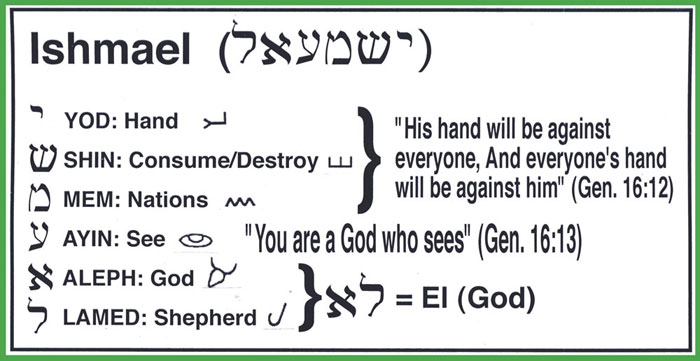  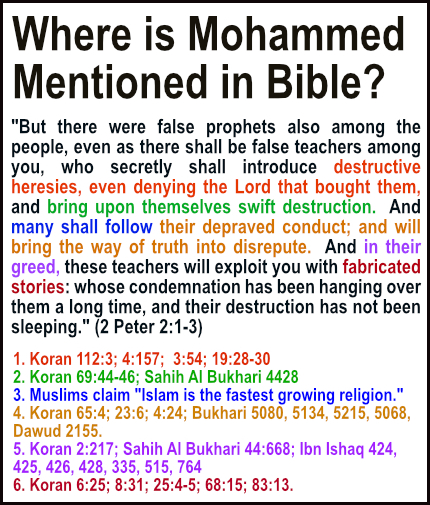 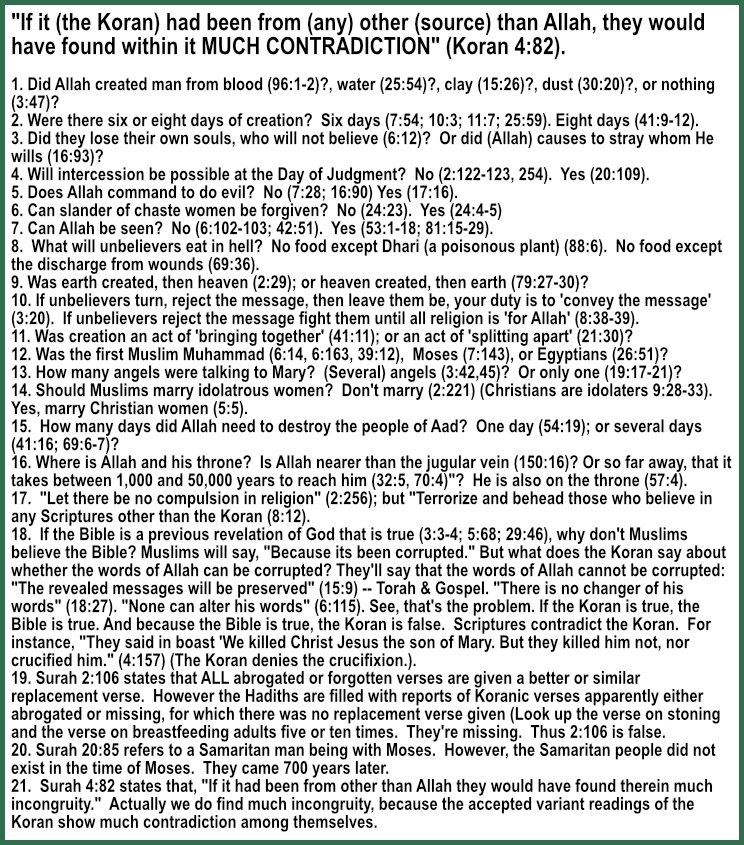 
Fulfilled Prophecy
There are no prophecies in the Koran. No fulfilled prophecies given as evidence of its inspiration (Isa. 46:9-10). But in the Bible, there are many fulfilled prophecies given as proof of inspiration. Written sometimes thousands of years in advance. Like a "wild ass" (Gen. 16:12), Ishmael (Arabs) was given "the wastelands as his home" (Gen. 28:8; Mal. 1:2-3) and "searcheth after every green thing" (Job 39:5-8). Green represents Paradise to Muslims. Mohammed is said to have worn a green cloak and green turban, and his writings are full of references to his favorite color -- green. Sura 76 says believers in Allah in Paradise wear fine green silk. It is interesting that the "pale horse" ("chloros" -- Green) has power over one fourth of the earth (Rev. 6:8). The world population is 6,784,003,735 (6.8 billion) and the Muslim population worldwide is 1.82 billion. Islamic nations also cover one quarter of the earth.
.jpg) 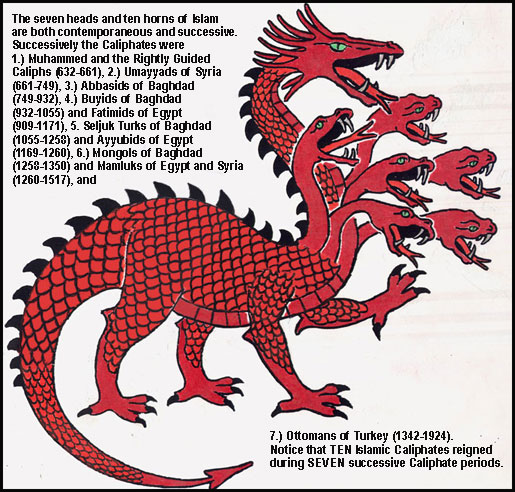 
Arabs are fiercely independent, and are dangerous when attacked. In spite of the pressures brought to bear upon Arab nations, and their common hostility towards Jews, there has been little unity among them. Proclamations of Arab unity have been made but seldom properly implemented. In fact, the disunity among the Arab nations illustrates the truth of Genesis 16:12 to this day: "He (Ishmael) will be a wild ass of a man his hand shall be against every man and every man's hand against him." The reference to the wild ass (as the Hebrew text has it) is appropriate. It is the image of the free, intractable bedouin character. As Job says, the wild ass is untamable, roaming at will in the desert, a wonderful symbol of the bedouin's boundless love of freedom and independence. The statement "his hand shall be against every man and every man's hand against him" is an accurate description of the constant feuds among Arabs to this very day.
Egypt, at one time or another, has sent troops into Syria, Iraq, Kuwait, the Sudan, Algeria, Yemen. Its air force has raided Saudi Arabia and Yemen. It has bitterly fought Israel, but recently has signed a peace treaty with that nation.
Syria has sent troops into Iraq and Jordan on occasions, and has attempted to instigate rebellion in both of them at other times.
Iraq has sent troops into Jordan, has massed troops to threaten Syria, has attempted to instigate coups and rebellions there on more than one occasion, and, recently launched an attack on Iran.
Saudi Arabia has sent troops into Jordan a number of times, into Kuwait once, and has interfered in Yemen on several occasions. It has attempted to instigate rebellion and political assassination at one time or another in Syria, Jordan and Egypt.
Jordan has sent troops in Kuwait, massed troops against Syria, involved itself in Yemen. King Hussein of Jordan lost control of the West Bank because of his dull-witted and stubborn involvement in the Six Day War with Israel.
The Arabs argue over many things important and trivial. Iraq and Syria still quarrel over the correct interpretation of Baathist socialism. Iran and Iraq are divided over religion as well as claims of territory. Both are Islamic countries, but each supports a different and opposing sect. For there are several bitterly divided sects among the Moslems. The two chief branches are divided into the Sunni and Shi'a sects. Then there are the Kurds. They represent almost 20% of Iraq's population, and have been fighting for their independence for more than fifty years. Until the outbreak of war between Iran and Iraq, these two powers co-operated in suppressing the Kurds! The United Arab Republic formulated some time back by Syria and Egypt, shortly afterwards disintegrated, and today is no more!
With all these confusing and conflicting factions, the Arab world remains very fragmented, lacking any unifying leadership, illustrating to this day the prediction of God to Hagar concerning her son Ishmael. Nor does the Koran hinder the prophecy whatsoever. The Koran provides another fulfillment of the prophecy when it says, "Take not the Jews and Christians for friends ... slay the idolaters [infidels] wherever you find them, and take them captives and besiege them and lie in wait for them in every ambush... Fight against those who ... believe not in Allah nor the Last Day" (Sura 5:51; 9:5,29,41). Ishmael's descendants take this literally.
The "king of fierce countenance" (Dan. 8:23) is the entire dynasty of Caliphs whose Islamic creed is essentially warlike. They "understand dark sentences" in the Koran. In fact, Psalm 49:3-4 compares wise, understanding thoughts and "parables" to opening a "dark saying." They are not "by his own power" -- not Mohammed's own flesh and blood descendants (cp. Dan. 8:22,24). "By peace ("Salama" or Islam) he shall destroy many" (Dan. 8:25). Moslems believe it is not necessary to keep treaties with infidels and so use "crafty deceit." (Hudna) "But he shall be broken without (human) hand" (Dan. 8:25). Both the Arab and Turkish Empires collapsed as a result of internal corruption. Quarrels over the Caliphate resulting in the rival Umayyaid and Abassid Dynasties as well as Islam splitting into Sunni and Shia sections caused the collapse of the Arab Empire. "Many shall be purified and made white and tried" (Dan. 11:33) because of martyrdoms under pagan Rome and Papal Rome. Daniel 11:40-45 mentions the "King of the South" (Arab Moslem Empire) conquering "south" (Arabian Peninsula), "east" (Mesopotamia and Persia) and into the "pleasant land" (Syria and Palestine). Professing Eastern Christians were cast to the ground and stamped upon by Moslems. Between 634 and 644 A.D., the Caliph Omar was responsible for the destruction of some 4000 places of Christian worship. Christians under Moslem rule were restricted in their worship, trade, commerce, dress and travel. The Turks entered the "glorious land" but Ammon, Edom and Moab escaped the Ottoman Empire because they were wandering Arab tribesmen who already accepted Islam. Egypt "shall not escape" when in 1516-1517 the Ottoman Emperor Selim I marched into Egypt and stripped it of its wealth and moved 500 Egyptian families from Cairo to Constantinople. In 1550 the Turks made Libya pay tribute. "All the princes who were before tributary or confederate to the late Sultan of Egypt even to the most mighty king of Ethiopia without delay entered into like subjection with the Turks" (Rycaut's Turkish History1:375). Both the "King of the South" (Arab Empire) and the "King of the North" (Turkish Ottoman Empire) push at "him" -- apostate Christianity -- who doesn't regard the "desire of women" (celibate), speaks "against the God of gods" (blasphemes), honors the gods of forces or the god that protects (guardian or patron saints) as well as honouring a god hitherto unknown, with gold, silver and precious stones whenever they worship the Host or wafer-god set up in a gold or silver monstrance adorned with precious stones (Dan. 11:36-39). The Pope "shall exalt himself ... above every god" (11:36). The "King of the North" causes the banks of the Euphrates to "overflow" (Dan. 11:40). Verse 41 should read, "He shall enter also into the glorious land, and many shall be overthrown." (Crusades) Gibbon says, "Jerusalem ... soon became the theatre of nations" (Decline and Fall10:375). The "tidings out of the east and north" that "trouble him" are Russia's victories against the Ottoman Empire. From the mid-1700s onward, Russian attacks upon the northeast border of Turkey became increasingly frequent. Turkish armies and navies attacked Russia "with great fury" but unsuccessfully. In 1768, Turkish armies were badly defeated and in 1770 the Turkish navy was obliterated.
In 1774 and 1777 more defeats occurred. In 1806 the Russians seized Moldavia and Wallachia, and destroyed another Turkish fleet. In 1826, Turkey surrendered all fortresses in Asia to the Russians. Russia again defeated the Turks in the Crimean War of 1853. During the First World War, the Turks established their military headquarters in Jerusalem at Mount Zion. He planted the "tents of his army" "between the seas and the glorious holy mountain" (Dan. 11:45). General Allenby drove them out in December 1917. Turks subsequently lost Baghdad, Damascus and Aleppo in 1918 -- three capitals of the pre-Roman King of the North. Deserted by their German allies, the Turks surrendered. He came "to his end and none" helped him (Dan. 11:45). Within six years the Ottoman Emperor had been deposed, the Caliphate abolished and Turkey declared a Republic under Mustapha Kemal. From the Hegira in 622 A.D. to the surrender in 1917 A.D. was 1335 years (Dan. 12:12). From the Hegira in 622 A.D. to 1844 A.D. when the Sultan of Turkey issued a Decree of Religious Toleration for Moslems who convert to Christianity was 1260 days (Dan. 12:7). From 622 A.D. till 1912 A.D.when the Balkan War occurred that greatly weakened Turkey is 1290 years. From 634 A.D. when the Caliph Omar, who conquered Jerusalem and established the Arab empire, began to rule, to 1924 when the Islamic Caliphate was abolished was 1290 years (Dan. 12:11). From 632 A.D. when the Caliphate was established to 1922 when the Turkish Ottoman Empire came to an end with the abdication of the Sultan was also 1290 years.
The fourth beast of Daniel 7 is the same as the first beast of Revelation 13. It is Islam. The two beasts of Revelation 13 are the beast with seven heads and ten horns (Islam taking over Babylon, Medo-Persia and Greece) and the beast with two horns (Mohammed succeeded by his Sunni Caliphs and Shia Imams culminating in Mahdi). The head that died is Muhammed. But it was healed by Abu Bakr. The seven heads and ten horns of Islam are both contemporaneous and successive. Successively the Caliphates were 1.) Muhammed and the Rightly Guided Caliphs (632-661), 2.) Umayyads of Syria (661-749), 3.) Abbasids of Baghdad (749-932), 4.) Buyids of Baghdad (932-1055) and Fatimids of Egypt (909-1171), 5. Seljuk Turks of Baghdad (1055-1258) and Ayyubids of Egypt (1169-1260), 6.) Mongols of Baghdad (1258-1350) and Mamluks of Egypt and Syria (1260-1517), 7.) Ottomans of Turkey (1342-1924). Notice that TEN Islamic Caliphates reigned during SEVEN successive Caliphate periods. Revelation 13:18 states, "Let him reckon the multitude of men belonging to the beast, for it is a multitude of men, and his multitude is IN THE NAME OF ALLAH." (Bism-alla). Thus the Shahada badge of servitude is the "one good deed" that pardons a "long list of sins" (Quran Tirmuthi 2639). It is a green headband and green armband and green flag that are the Islamic counterfeits for Jesus Christ and all have 666. During Salah, Muslim prayers, the name "Alu Akbar" is repeated constantly and is recited exactly 111 times per day for six days: Saturday through Thursday: 111 x 6 = 666. Furthermore, in Islam, 666 is considered to be a holy number. In Revelation 17 a wealthy harlot sits on this beast with seven heads and ten horns. Who is the harlot? The House of Saud which is fabulously wealthy due to her "wine" of petroleum fornication (17:2). She has prostituted herself to the west and the west is "drunk" or "addicted" (17:2). The oil money is used to fund militant Islamic terrorist organizations (Hezbollah & Hamas) which then kill Jews and Christians ("saints") (17:6). Many Arab neighbors "hate" (17:16) the House of Saud because she has partnered with the "Great Satan" (U.S.) -- oil for protection -- and we have protected her with our military. Soon they will "burn her with fire" (17:16). Many Riyadh skyscrapers remind us of ancient Babylon and its tower making the name "Mystery Babylon the Great" (17:5) very appropriate. Most of Saudi oil (90%) comes from seven massive oil well fields or "seven mountains" (Rev. 17:9) (Ghawar 5,000,000 barrels daily, Safaniya 960,000, Abqaiq 650,000, Berri 400,000, Zuluf 500,000, Marjan 400,000 and Abu Sa’fah 150,000) (Matthew R. Simmons, Twilight in the Desert, p. 89). Furthermore, Mecca is situated on seven literal mountains: Jabal Thugbah, Jabal Ishfa, Jabal Laban, Jabal Khashrab, Jabal Thawr, Jabal Arafat, and Jabal Ismar. (Istanbul, Turkey's capital, also is built on seven hills. The first hill contains Hagia Sophia Mosque. On the second hill is the Nuruosmaniye Mosque. The third hill is now occupied by the Bayezid II Mosque to the south and the Süleymaniye Mosque to the north. The fourth hill has the Fatih Mosque. On the fifth hill we find the Mosque of Sultan Selim. On the sixth hill are to be found the districts of Edirnekapi and Ayvansaray. The seventh hill extends from Aksaray to the city defense walls and the Marmara. It is a broad hill with three summits producing a triangle with apices at Topkapi, Aksaray, and Yedikule.) The seven kings are the seven Caliphates mentioned above, of which five are fallen (Umayyads through Mongols) and one is (Ottoman Turks) and the other not yet come (the last Caliphate led by al-Mahdi for seven years). Muslims buy many companies and make it very clear they won't do business with non-Muslims (can't buy or sell without mark). Revelation 20:4 mentions "them that were beheaded for the witness of Jesus, and for the word of God, and who had not worshipped the beast, neither his image, neither had received his mark upon their foreheads, or in their hands" which is the method of execution used by Islam. Sura 8:12 says, "Strike off their heads."
 
The Mahdi will sign a seven-year Peace Treaty with Israel but will break it in the middle (Dan. 9:27). Perhaps the treaty will be "Submit to Islam or go without oil" since "The highways lie waste, the wayfaring man ceaseth; he hath broken the covenant, he hath despised the cities, he regardeth no man" (Isa. 33:8). Western democracies need to avoid this intoxicating wine of this petro-dollar harlot since it supports Islamic regimes who murder Jews and Christians. Leviticus 26:16 indicates that the "terror" is "behalah" #928 which sounds like "beh Allah." Islam has absorbed Babylon, Medo-Persia and Greece as God said it would (Daniel 7; Rev. 13:2). The Roman Empire never absorbed the three previous beasts. Islam was "different" from previous empires because it was religious not just political (Kaliph & Pope were both religious for 1260 years). Furthermore, Islam has TEN rulers (toes or horns) (Dan. 2; Dan. 7; Rev. 13). Mohammed had TEN disciples -- his Council of TEN: Abu Bakr Sadiq, U'mar ibn al-Khattab, Uthan bin Affaan, Ali Ibn abi Talib, Abdur-Rahman bin Aawf, Sad ibn Abi Aaqqas, Said ibn Zayd, Abu Ubaydah bin Jirrah, Talhah ibn Abdur Ubaydullah, and Zubayr bin Al-Awam. The first THREE Caliphs (successors of Mohammed), which were THREE of Mohammed's Council, are not recognized by the Shia sect of Islam, because they were not related to Mohammed. They are: 1. Abu Bakr Saddiq, 2.U'mar ibn al-Khattab and 3.Uthan bin Affaan. They were chosen by the strong majority sect of Islam -- the Sunnis (strong iron 90%). But "there came up among them another little horn before which there were THREE of the first horns plucked up by the roots" (Dan. 8:7). This was Ali and his Shia branch (weak clay 10%) which nullified the legitimacy of the previous THREE Caliphs who were not related to Mohammed by blood (see also Dan. 7:7-8, 21-26). "A divided kingdom" (Dan. 2:41). "They mingle ("arab") but do not adhere to one another" (Dan. 2:43). Another fulfillment of the ten contemporaneous horns will come: Psalm 83:6-9 actually names them: Edom, Ishmaelites; Moab; Hagarenes; Gebal, Ammon, Amalek, Philistines, Tyre, Assyria and Lot. "Do to them as you did to Zeba and Zalmuna" (Ps. 83:11) when Gideon (a type of Messiah) slew them "and took away the ornaments (Heb. "saharon" or crescents) that were on their camels' necks." (Judges 8:21) just as Messiah will remove the crescents from the Moslem minnarets and Mosques when he returns.
The ten contemporaneous horns may be the ten nations drawn up following the defeat ("deadly wound") of the Ottoman Empire by the British after World War One in 1920-22. They were Basrah, Baghdad, Mosul, Syria, Lebanon, Saudi Arabia, Jordan, Turkey Persia (Iran) and Egypt. Under British mandate Basrah, Baghdad and Mosul were later consolidated ("three horns uprooted") into provinces of Iraq. This agrees with Daniel in that one "little horn" (British) subdues three. Interestingly, the ruler of Iraq is now the U.S. president! That could be very significant! Babylonian and Medo-Persian and Greek Empires became Iraq, Iran, Turkey,Syria, Jordan, Pakistan, Saudi Arabia, Libya, Egypt, Lebanon, etcetera. Shiahs consider their Imams to be infallible, sinless spiritual guides. Further, the "twelvers" of the Shia branch believe this divine-like nature to be continued to the present day through their 12th Imam -- the Hidden Imam -- the Mahdi -- "like a man" but not human -- divine. How else could he be alive after 1200 years? Mahdi is the Antichrist. Thus he can sit in the "Temple of God" (2 Th. 2) which is where the Dome of the Rock is located.
The Mishnah refers to the solid rock structure as the "Foundation Stone" upon which the Ark of the Covenant was secured. This is the rock housed by this Dome. Blasphemy is inscribed on the walls of this Dome of the Rock. Therefore this structure is the Abomination standing in the Holy Place (Matt. 24:15), so Antichrist must be Moslem. He sits in the Dome of the Rock. He "changes times and laws (Sharia Law & Moslem Calendar). He denies Jesus is the Son of God (1 John 2:22). He denies that Jesus was God made flesh (2 John 1:7; 1 John 4:2-3; cp. Luke 1:30-35) according to the Quran 4:157-159 (Isa wasn't crucified), 6:101 (How can Allah have a Son when he has no consort?), 4:171 (Jesus was only an apostle of God ... for God is only one God; and far from his glory is it to beget a Son). Shia Islam's "promised one" is the Antichrist or "False prophet" of the Bible. Muhammed b. Hasan 12th Imam, was born 872 A.D. ("the beast was" -- 17:8) but his body was never found. Legend says he never died. He has been in "hiding" for the last 1200 years ("is not" -- 17:8) but will reappear as al-Mahdi ("shall ascend from the pit" -- 17:8) or "Master of the Age" and be cast into hell fire (17:8)
In the future, the Arabs will become a great nation. In response to Abraham's prayer, "O that Ishmael might live before Thee," God promised, "I will make of him a great nation." Although the Arabs ruled a great empire from about 637 till 937 A.D. -- 300 years -- that prophecy has yet to be fulfilled when Arabian "deserts shall blossom as the rose" (Isaiah 35:1), and instead of the burning heat of their sandy wastes, there will be "forests in Arabia" (Isaiah 21:13), and water in abundance (Isaiah 21:14). The Bible declares of certain Bedouin Arab tribes descended from Ishmael: "They shall shew forth the praises of the Lord." Their offerings "shall come up with acceptance on Mine altar, and I will glorify the house of My glory" (Isaiah 60:6-7). Before they can be truly "great," they will have to replace the Koran with the Bible. They will have to change from the worship of Allah to that of Yahweh the God of Israel (Exodus 3:14). They will have to acknowledge Yeshua instead of Mahomet. Their mutual antagonism and restlessness will have to end. Their hatred of Israel must cease, and they will make pilgrimages to Jerusalem instead of to Mecca (Zechariah 14:16).
.
Chapter 9a Star Chart: Adding 360 degree-years to 402 A.D. (SUN in Sagittarius -- Alaric "stood at the (church) altar (Ara), having a GOLDEN censer" -- Rev. 8:3) we come to 762 A.D. when Al Mansour laid the foundation of the new capital at Baghdad (back again to SUN in Sagittarius -- "horses ... on their heads ...CROWNS like gold" -- Rev. 9:7).
With 762 as a reference point in Sagittarius, we can count backward to 622 to begin our story. "To him (Leo; Mohammed) was given the key (Al Phard [separated; put away]; Kaaba Stone) to the bottomless pit" (hole in Hydra's snake wall; Kaaba; the cave of Hera) (9:1) in 622 A.D. Just as the black star FELL out of the wall and Mohammed PUT IT BACK IN around 606 A.D., so also Mohammed himself lost power and FELL from office -- "a fallen STAR" -- but was PUT BACK IN office in 622 A.D. (Hegira) counting counter-clockwise from Sagittarius. The "black meteorite" at Mecca is therefore a type of Mohammed himself. Both are helplessly inside of Hydra's coil (Satan -- Luke 10:18).
The key had been the emblem of the family of Mohammed because of that family's role as guardian of the sacred, black Kaaba stone of Mecca and the keys of Kaaba were held by Mohammed's family, the House of Koreish, who for four generations were governors of Mecca; but his grandfather and father died while he was young and he became orphaned and destitute (Gibbon 4:260).
The black Kaaba (Cube) is richly embroidered and contains the black meteorite, just as the black Zodiac is also a cube "richly embroidered" and contains the black new moon in Capricorn with the silver crescent frame. Notice the two golden doors of the Kaaba, to the right of the silver crescent frame. It is apparently possessed by evil spirits (constellations). Pilgrims (constellations) walk around the cube (Zodiac) COUNTER-CLOCKWISE. We count degrees going CLOCKWISE. This is just another indicator they are headed in the WRONG direction. There are no red radius lines, other than the 5th Trumpet, because none of the idol constellations can "see ... hear ... walk" (9:20) or speak, which is what red radius lines represent. However, the red radius line may represent a red "key" in the sun hole and "hair like women's hair" (9:8). This red radius line also represents "breastplates of iron" (9:9), a red trumpet, and two doors of the Kaaba. There are six sixes formed by six different snake coils -- each one near a significant event in this starchart. Signatures of Caliphs often also have ornamental squiggles that appear to be the number "6".
Mohammed's night journey from Mecca to Jerusalem's Temple Mount (Al Aqsa Mosque) (There are 666 nautical miles from the Kaaba stone in Mecca to the Al Aqsa Mosque in Jerusalem.) is portrayed by the black Zodiac's Milky Way. Then Mohammed climbs seven stages of heaven on the winged horse Al-buraq (Pegasus) portrayed by Perseus rising in the air (Milky Way) from Sagittarius. He supposedly spoke with Abraham, Moses, Jesus, John the Baptist, etcetera. Muhammad was then taken to a holy tree in the seventh heaven (Mulberry in Canis Minor) that Gabriel was not allowed to pass. Here, according to Islamic tradition, God instructed Muhammad that Muslims must pray five times per day. Perseus holds Medusa's head in one hand because Mohammed turns hearts from flesh to stone (from converted Christian to unconverted -- Ez. 11:19; 36:26). In the other hand, Perseus holds a sword. So does Sagittarius. As Mohammed said, "The (red radius line) SWORD is the KEY to heaven and hell" (Gibbon 27:461). The "bottomless pit" is the black moon in Capricorn and the "smoke of the pit" is the Milky Way (9:1-2). It is remarkable that Mohammed died and Abu Bakr took over in 632 A.D. in a black Leo the lion.
Next notice TWO WINGS of Corvus in 657 A.D.: Ali Bin Abu Talib, ruler of the Islamic realm, fought against Muawlya bin Abu Suflan, governor of Syria, who wanted to be independent from the realm. After the Battle of Seffeen there was a split in Islam. Those who supported Ali were called the Shiia'ats who were mostly in Iraq and Iran, and those who supported Muawlya are the Sunies. So the Muslims were divided into TWO political factions -- TWO WINGS.
Next we come to Sagittarius ("like HORSES prepared unto battle" -- 9:7). If we subtract 7°-12° years from our solar reference point of 762 A.D., we come to 750-755 A.D. -- the bow in Sagittarius: Abbasids assumed control of the Islamic world from 750-937 A.D. and moved the capital to Baghdad Iraq. But Spain fell under the control of an escaped descendant of the Umayyad family (661-750 A.D.) -- a SECOND caliph who landed in al-Andalus and created the "Golden Caliphate", Abd al-Rahman. He was recognized in Cordova Spain in 755 A.D. -- just as the bow of Sagittarius looks like TWO goat HORNS. Whenever we encounter TWO HORNS, a new caliphate begins. Then in 788 a new Idrisid Caliphate of Maghreb (Morocco) rebelled against the Arabian Caliphs and established an independent state corresponding to the crescent horn near the tail of Sagittarius ("tails like scorpions" -- 9:10; 788-974 A.D.). Notice that the Moslem goat (Capricorn -- Dan. 8) now has THREE HORNS or CALIPHATES (Abbasid, Umayyad and Idrisid). Later the Fatimid Caliphate (909–1171) was founded in 909 as the higher of two HORNS of Taurus by the eleventh Imam Abdullah al-Mahdi Billah and spanned a large area of North Africa. If we add 150° years ("five months" -- Rev. 9:5) clockwise from 762, we arrive at 912 A.D. (gibbous MOON in Taurus) when Abd Ar Rahman III of the deposed Umayyad Dynasty, conquered Andalusia from the Abbasid Caliph and reigned. This was called the Cordoba Caliphate of Spain (912-1031 A.D.). This is the lower horn of Taurus -- 3° later. Notice also the BLACK CRESCENT horn and WHITE gibbous TURBAN crown horn on Taurus -- indicating a total of FOUR contemporary CALIPHATES (Abbisid, Idrisid, Fatimid and Cordoban or Umayyad). Notice also the image of TWO much larger, 150°, HORN CRESCENTS forming the timeline -- indicating the duration of the Moslem goat's empire.
Adding 150° years or "five months" more clockwise (Rev. 9:10), we come to 1062 A.D. (CRESCENT in Libra). Persian Buyids ruled Baghdad from 945 till 1062. Seljuks took over from 1062 till 1258. Both had Abbasids as puppets, whose real power ended in Baghdad in 937 with the assassination of the bodyguard loyal to the Abbasid caliph (Rev. 13:13). The Milky Way is the Nahrawan Canal -- the key to making local Baghdad agriculture the breadbasket of the Abbasid capital. In December 1055 al-Malik al-Rahim was arrested and deposed by Toghrul Beg's forces in Baghdad, bringing an end to Buyid rule in Iraq. Abu Mansur Fulad Sutun, who once again acknowledged his authority, however, was able to remain in power in Fars for another seven years as a Seljuk vassal. Constant fighting with his brothers, however, weakened his rule, and in 1062 he was killed while fighting against the Kurdish Shabankara tribal chief Fadluya. The Seljuks shortly afterward entered Shiraz and took control of Fars. By 1062, the prophet Daniel's words seem to apply: "Thou (fat Buyid crescent) art weighed in the balances and found wanting...Thy kingdom is...given to the...Medes and Persians" (Dan. 5:27). Remarkably, the Seljuk conquerors dwelt in Media and Persia and adopted the Persian culture and language.
Just as Moslems conquered the southern 1/3 of the Roman Empire in 150 years, so also Moslems may conquer the southern 1/3 of the United States in 150 days. "The thing that hath been, it is that which shall be; and that which is done, is that which shall be done" (Eccl. 1:9). God says, "I change not" (Mal. 3:6). He is "the same yesterday, today and forever" (Heb. 13:8).
|
Chapter 9a -- Moslem Arabs Torment Southern Third of Roman Empire
"And the fifth angel sounded (the trumpet with red radius tube with solar bell end. See starchart 9b), and I saw a (black meteorite) star fall from heaven (government) unto the earth: and to him (Mohammed) was given the key (black meteorite) of the (stone cavity) bottomless pit" (9:1).
Historically, who is the STAR? The "STAR" that fell from heaven is SATAN because Christ said, "I beheld SATAN as lightning FALL from HEAVEN" (Luke 10:18). "How art thou FALLEN from HEAVEN (removed from office), O LUCIFER ... thou shalt be brought down ... to the sides of the PIT" (Isa. 14:12-15). Furthermore, verse 11 confirms this by calling him "DESTROYER." When paganism was overthrown, Satan fell (Rev. 12:9). But Satan then opened the prison of evil spirits and inspired an Arab of Mecca in 605 A.D. named Mohammed. "For there shall arise false Christs and false Prophets ... behold I have told you before ... if they say unto you behold he (Mohammed) is in the desert (of Arabia), go not forth: behold he (the Pope) is in the secret chamber (Cardinals sealed inside Sistine Chapel whenever they vote for a new Pope), believe it not" (Matt. 24:24). The fact that Moslems want to exterminate Jews and Christians and ban the Bible is proof that Allah is Satan. Isaiah 14:12 mentions "Lucifer" which in Hebrew is "Hilal bin Sahar" which means "CRESCENT MOON Son of the Morning" in Arabic. Thus Satan is symbolized by a CRESCENT or Morning Star. Satan masquerades as an angel of light. Among Islam's 99 names of Allah are "Most Proud One"(Isa. 14:13-14), "Afflicter," "The One Who Causes Death" (Destroyer) (Rev. 9:11), "Great Deceiver" (Rev. 12:9) and "Great Plotter." The Hebrew word for "curse" is "alah" (# 423 of Strong's) (see Dan. 9:11). The name "Allah" can be broken down into the Hebrew "Al" meaning "No" (#408) and "lah" meaning "Law" (#3809) or "No Law" -- the man of LAWLESSNESS (2 Thess. 2:3-4). Who is the STAR? The Nestorian monk Sergius was excommunicated for heresy and immorality and then wrote the Koran before being put to death by Mohammed to keep it a secret. A falling star is a leader who is removed from office (Dan.8:10; 12:4). Prideaux's Life of Mohammed talks about Sergius. Who is the STAR? The Kaaba Stone is a black meteorite (star) that fell from heaven. Moslems kiss and caress it when they make pilgrimages to Mecca. Who is the STAR? Just as Perseus rotated down to the horizon ("a fallen star"), so also Mohammed was a prince by birth of the house of Koreish, the heir of the rulers of Mecca who possessed the "keys of Caaba"-- symbolic of rulership. The keys of Kaaba were held by Mohammed's family, the House of Koreish, who for four generations were governors of Mecca. But his grandfather and father died while he was young and he became orphaned and destitute (Gibbon 4:260). He lost power and fell from office -- "a fallen star." Perseus holds Medusa's head in one hand because he (Mohammed) turns hearts from flesh to stone (from converted Christian to unconverted -- Ez. 11:19; 36:26). In the other hand Perseus holds a SWORD. As Mohammed said, "The "SWORD is the KEY to heaven and hell" (Gibbon 27:461) (9:1). Furthermore, Cassiopeia (enthroned woman) is alternately symbolized by a "Laconian KEY" which opens the bottomless pit or horizon as stars rise up from it.
"As a young child," writes Ramon Bennett, "Mohammed was nursed by a Bedouin woman by the name of Halima. In his third and fourth years, 'The child had had numerous fits, which made Halima think he was demon-possessed' (Shorrosh, Islam Revealed, p.48). Early Moslem tradition records that when Mohammed was about to receive a revelation from Allah: 'he would often fall down on the ground, his body would begin to jerk, his eyes would roll backward, and he would perspire profusely. They would often cover him with a blanket during such episodes' (Morey, The Islamic Invasion, p.71). It was while Mohammed was in this 'trance-like' state that he received his 'divine revelations.' After the trance, he would rise and proclaim what had been handed down to him' (ibid.)" (The Great Deception, Philistine, p.43). Many biographies of Muhammed believe he suffered from epilepsy -- but this is clearly demon influence. It took 24 years to write the Koran which has 100 chapters. The Koran preaches hatred and slavery in thought, word and deed. The Koran is a combination of Old and New Testament scriptures combined with Apocrypha and Pseudepographa writings mixed with paganism of the Arabs.
What is the KEY? The black stone itself fits into the silver frame like a key. The KEY has been the emblem of the family of Mohammed because of its role as guardian of the sacred, black Kaaba stone of Mecca. The Moorish followers of Islam displayed the KEY on their banner as they advanced across north Africa into Spain. The KEY was also engraved upon the arch of Alhambra, the Moorish palace in Granada. Furthermore, the Koran says, "Did not God give to his Legate (Mohammed) the power of heaven which is above, and the fire which is beneath? With the KEY did he not give him the title and power of a porter that he may open to those whom he shall have chosen?" ( Peyron, Jean-François, Essais Sur l'Espagne, 1789, London, Vol. 3, p.189). What is the KEY? The "SWORD is a key to heaven and hell" (Koran). "I have been given the keys of all the treasures of the earth" (Sahih Bukhari 2:428). The fifth star in Ursa Minor took his Spanish/Portuguese hunting horn -- or red radius tube with sun bell end -- and blew it. Then a "STAR" (angel -- Rev. 1:20) fell from heaven called SATAN (Luke 10:18; Isa. 14:12-15; Rev. 12:9) who inspired an Arab of Mecca named Mohammed in 605 A.D. "Each year during the month of Ramadan, he would withdraw from the world and …in the cave of Hera, three miles from Mecca, he consulted the spirit of fraud or enthusiasm whose abode is not in the heaven, but in the mind of the prophet." (Edward Gibbon. 'Decline & Fall.' Vol V. p 396-397).
"And he opened the bottomless pit (by inserting the black meteorite); and there arose a (Milky Way) smoke out of the (stone cavity) pit, as the smoke of a great (Arabian) furnace; and the sun (Christian emperor) and the air were darkened by reason of the (Milky Way) smoke of the (stone cavity) pit" (9:2).
How is the PIT opened? Two crescents form a round dark opening to the PIT or CAVE in Capricorn -- the Moslem goat (see Star Chart 9b). One day at age 40, he entered the mouth of the CAVE (Gibbon 4:260) at the foot of Mount Hera. He was shaken by an unseen power. A light flashed and the Angel Gabriel (Satan impersonating Gabriel) stood before him. Mohammed said "the Angel Gabriel" dictated to him the Koran in this CAVE which was the "bottomless PIT." Mohammed formulated his religious doctrines in a CAVE. His experiences were similar to the witch of Endor hearing the prophet Samuel, or the "voices" heard by Joan of Arc or the "visions" of Lourdes and Fatima. (Incidentally, Mohammed's daughter was named "Fatimah" also.) He ran home and told his wife (a wealthy widow named Kadijah who was 15 years older than him) he was possessed of a devil and had gone mad. She told him he was a prophet. He went into trances in which he had visions of the supposed sensual delights of Paradise, of the material torments of hell, and so on, all of which showed that he was a medium for Satan. Those who witnessed Mohammed fall into his strange trances, described him as one indwelt or possessed by genii or spirits. He wrote the Koran to imitate scripture while denying Jesus was anything but a good man. The Koran says that Noah's flood occurred in Moses' time (Sura 7:136; cf. 7:59); that Abraham attempted to sacrifice Ishmael, not Isaac, and that Mohammed is called the Comforter rather than the Holy Spirit. "Take not the Jews and the Christians for your friends... Allah's curse be on them: how they are deluded away from the truth" (Sura 5:51; 9:30). The Koran denies the inerrancy of Scripture. He publicly declared himself a prophet in 610 A.D. Notice that both "little horns" of Daniel began in 606-610 A.D.
A FURNACE is a HOT PLACE such as a DESERT. Astronomically, John saw Scorpio ascending from the burning furnace-altar Ara. According to the Aztecs, Corvus is another scorpion (attacking the Roman hydra dragon) (9:3). The Milky Way billowing up from Ara is the smoke. But historically what is the SMOKE of the pit? Dark SMOKE covering the light is HERESY. Furthermore, if the SUN is DARKENED, all that is left in the sky is the MOON and STARS -- a popular symbol of ISLAM. Algeria, Malacca, Mauritania, Cyprus, Pakistan, Tunisia, Turkey, etcetera, all have a CRESCENT and five-point STAR. Malaysia uses a fourteen-point star. The flags of the Arab League, Iran and the Maldives use a CRESCENT without any STAR. But the SUN is ABSENT from all Islamic nations' flags. This opened the bottomless pit (beneath the celestial horizon) and there "arose a SMOKE" (the Milky Way; heresy; Satan) out of this pit (cave of Mt. Hera) as if it were a "great furnace" of the hot Arabian desert (Ara, the altar). This brought on the DARK Ages in Europe ("sun and sky DARKENED"-- 9:2). The Messiah and the Byzantine emperor are the SUN (Mal. 4:2) and the Messiah is the "light of the world" (John 8:12) and truth but the TEACHING of Islam (smoke or error) darkened the sky and sun, obscuring their influence (in Sagittarius), leaving the moon and/or stars as the symbol of Islam on all Islamic Flags. Notice that if the sun is placed in the smokey Milky Way, the lunar crescent can appear in Capricorn (the Islamic goat of Dan.8) forming a third GOAT HORN. The crescent also resembles a SCIMITAR which the Arabs used so successfully to stab behind enemy shields. From Tours in the west (732) to Vienna in the east (1683), the great crescent of conquered Moslem territory is formed through Europe.
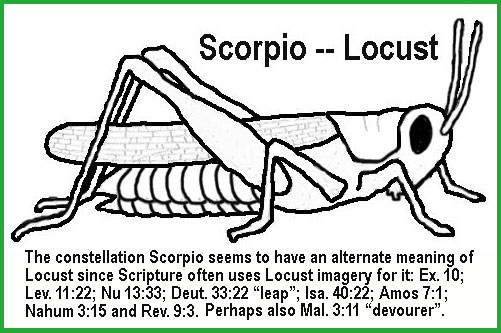
"There came out of the (Milky Way) smoke locusts upon the earth: and unto them was given power, as the scorpions (Scorpio has curved sword) of the earth have power" (9:3). The etymology of the Greek word for "deprived" combined with "Sarah" produces the word "Saracen" (Sarah + deprived) or Arab (cp. Gen. 21:10).

Who are the LOCUSTS? In Hebrew the word for LOCUST is "ARBEH" and for Arab is "ARBI." Exodus 10:13 says, "the EAST wind brought the LOCUSTS" (on Egypt). What country was EAST of Egypt? ARABIA. Midianites (Arabs) come as LOCUSTS for multitude (Judges 6:5). "In the Bedoween romance of Antar the LOCUST is introduced as the national emblem of the ISHMAELITES.... Mohammedan tradition speaks of LOCUSTS having dropped into the hands of Mohammed, bearing on their wings this inscription, 'We are the army of the Great God.'" (Forster's Mohammedanism Unveiled 1:217). The teaching of the Koran is described as SMOKE that darkens the sun or obscures the Byzantine Emperor's influence as well as the idolatrous Eastern Orthodox Church. Out of the pit come LOCUSTS like SCORPIONS which both come from ARABIA. The swarms of Saracen or ARABIAN LOCUSTS overspread the east and partially the west part of the Roman Empire. The maps above compare the range of the desert locust to the area occupied by the Saracen Empire. Notice the close similarity. Saracens are children of Sarah by Hagar. The Koran promises endless sensual pleasures as the reward of death in battle.
Why SCORPIONS? Being around "rebellious" "impudent" and "stiffhearted" men is like dwelling "among SCORPIONS" (Ez. 2:6). Rehoboam's reply to the deputation who wanted him to lighten the tax burden was, "I will chastise you with SCORPIONS" (2 Chr. 10:14) or impose OPPRESSIVE TAXES. In 612 A.D. Mohammed publicly proclaimed his mission to convert all so-called Christians and infidels to the Koran. These were Greek and Latin "CHRISTIANS" who were image-worshippers and idol-worshippers in practice -- who weren't "SEALED with the Holy Spirit" (Eph. 1:13) because they didn't depart "from iniquity" (2 Tim. 2:19). Moslems called them "dogs and infidels" and treated them accordingly. Arabs offered conquered peoples the choice of accepting the Koran, or of PAYING TRIBUTE MONEY, or of death by the sword (scimitar like a scorpion tail in shape and thrust point first just like a scorpion tail would strike). Christians could buy their liberty to continue in their own religion, but only at the cost of HEAVY TRIBUTE. This is the meaning of "as the torment of a SCORPION." See Jeremiah 8:3 and Job 3:2 for examples of those who prefer death to life. Muslim oppression of Christians whom they called "dogs" included prohibition of building new churches or ringing church bells, or the use of arms; an annual "life-redemption" tax, distinctive dress, the obligation to stand deferentially in presence of any Muslim and to admit any insulting Muslim to any church. Muslims offered strong inducement to apostasy with death penalty for return to Christianity. Christian women were also terribly abused. This is another SCORPION STING. But in 762 A.D., "War was no longer the passion of the Saracens" (Gibbon) and the Abaside Caliph began to construct a new capital east of the Euphrates called Baghdad. Also the Arabs pulled along in their REAR, "SCORPION" ARTILLARY which looked like "tails of SCORPIONS." They employed in their military operations formidable MISSILES which they styled 'SCORPIONS." These missiles were of a chemical mixture which was the forerunner of gunpowder. An Arab writer in 1249 speaks of them: "The SCORPIONS surrounded and ignited by nitrated powder, glide along like serpents with a humming noise, and when exploded, they blaze brightly and burn. Now, to behold the matter expelled was as a cloud extended through the air, which gave forth a dreadful crash like thunder, vomiting fire on every side and breaking down, burning, and reducing all things to ashes." This was known as Saracen fire -- later as Greek fire.
"And it was commanded them that they should not hurt the grass of the earth, neither any green thing, neither any tree; but only those men which have not the (star) seal of God in their foreheads" (9:4).
Which men had the seal of God in their foreheads? "To his Christian subjects (Nestorian Sabbath-keepers), Mohamet readily granted the security of their persons, the freedom of their trade, the property of their goods, and the toleration of their worship" (Gibbon 5:439; 390-391; 579-580). Mohammed wrote, "The sword is the KEY of heaven and hell; a drop of blood spent in the cause of God ... is of more avail than two months fasting and prayer." Unlike ordinary locusts, the Arabs did not lay waste the countryside. The Koran says, "Destroy no FRUIT TREES, nor any FIELDS of CORN, cut down no FRUIT TREES." Caliph Abu Beker ordered his Arabian officers and soldiers: "When you fight the battles of the Lord, acquit yourselves like men, without turning your backs. But let not your victory be stained with the blood of women or children. Destroy no PALM-TREES, nor burn any FIELDS of CORN; cut down no FRUIT-TREES, nor do any mischief to cattle, only such as you kill to eat ... As you go on, you will find some religious persons who live retired in monasteries, and propose to themselves to serve God that way: let them alone and neither kill them nor destroy their monasteries. And you will find another sort of people that belong to the Synagogue of Satan, who have shaven crowns (sun tonsure = ordained priest); be sure you cleave their skulls, and give them no quarter, till they either turn Mohammedan or pay tribute" (Gibbon's Decline and Fall, ch. 51:10 or vol. 5:189-190). Compare this with the wilful destruction of the Gothic invasion in Revelation 8:7 where we saw "all GREEN GRASS burned up." Symbolically green trees signify the righteous and dry trees the wicked (Ez. 20:46-47; 21:3-4; Luke 23:31). Even "In the 16th and 17th centuries support and encouragement for Protestants and Calvinists ... were one of the fundamental principles of Ottoman policy" (Halil Inalcik, History of Islam pp. 325-329). "There would have been no Protestantism had there been no Turk" (Kenneth Oster, Islam Reconsidered, p.72).
These Scorpions aren't allowed to hurt the trees or grass growing on the horizon since the Koran says, "Destroy no FRUIT TREES, nor any FIELDS of CORN" (Forster’s Mohammedism Unveiled (vol.i. p.403). Neither can they hurt Ophiuchus or Hercules, who are two constellations fighting Roman dragons, and thus have stars (the SEAL of God) in their FOREHEADS. The scorpions only hurt constellations without forehead stars (9:4). In other words, some "Christians" weren't "SEALED with the Holy Spirit" (Eph. 1:13; 2 Cor. 1:21) because they didn't depart "from iniquity" (2 Tim. 2:19). "God hath given (the Holy Spirit) to them that OBEY him" (Acts 5:32). "Bind (the COMMANDMENTS) ... on your FOREHEADS" (Deut. 6:8). Since a SIGN is a SEAL (Rom. 4:11), and the SABBATH is a SIGN" (Ex. 31:13), therefore the SABBATH is ONE such SEAL of the Holy Spirit. "And it (SABBATH-keeping) shall be for a SIGN unto thee upon thine hand, and for a memorial between thine eyes (FOREHEAD), that the LORD'S LAW may be in thy mouth" (Ex. 13:9).
"As soon as their numbers were complete, Abubeker ascended the hill, reviewed the men, the horses, and the arms, and poured forth a fervent prayer for the success of their undertaking. 'Remember', said the successor of the prophet, 'that you are always in the presence of God, on the verge of death, in the assurance of judgement, and the hope of paradise. Avoid injustice and oppression; consult with your brethren, and study to preserve the love and confidence of your troops. When you fight the battles of the lord, acquit yourselves like men, without turning your backs; but let not your victory be stained with the blood of women or children. Destroy no PALM TREES, nor burn any FIELD of CORN. Cut down no FRUIT TREES, nor do any mischief to cattle, only such as you kill to eat. When you make a covenant ... stand to it and be as good as your word. As you go on, you will find some religious persons, who live retired in monasteries, and propose to themselves to serve God that way: LET THEM ALONE and neither kill them nor destroy their monasteries. And you will find another sort of people that belong to the synagogue of Satan, who have shaven crowns; be sure you CLEAVE THEIR SKULLS, and give them no quarter, till they either turn Mahometans or pay tribute. (Edward Gibbon 'Decline & Fall', Vol.V:489-490).
Who were the men with shaven crowns? In the footnote Gibbon says, "Even in the 7th century the monks were generally LAYMEN; they wore their hair long and dishevelled, and shaved their heads when they were ordained PRIESTS. The circular tonsure was sacred and mysterious; it was the crown of thorns; but it was likewise a royal diadem, and every priest was a king." The shaved ring on their crowns represented the sun. This custom came from Babylon! Which Christians were protected by the seal of the Holy Spirit? "In the early centuries of the Christian era, the church of the East [not the Western or Latin church] sometimes called the Assyrian church, sometimes the Nestorian church [who observed the Sabbath] very effectively spread throughout Asia and the East, but remained separate from the church in the West, especially the apostasy. These true Christians became the teachers of the Saracens, and were responsible for establishing an educational system in Syria, Mesopotamia, Turkestan, Tibet, China, India, Ceylon, and other areas." (Elliott 'Horae Apocalypticae' p 461). The Arabs, like the Persians were very partial to the Assyrian Christians, because they found it necessary in the early days of their power, to lean upon the splendid schools which the church had developed. Medicine made great progress in the hands of the Church of the East. The Arabian court and its extended administrations employed its members as secretaries and imperial representatives... Assyrian Christians suffered comparatively little at the hands of the Moslems, but later much more at the hands of the Jesuits. The leader of the Church of the East sensing that the conquest of the Persian Empire was imminent, succeeded in obtaining a pledge of protection and freedom of worship on condition that the Christians paid certain tribute...These immunities by Abubeker were not only confirmed by Omar his Successor, but even the taxes were remitted..." "When the Arabian empire was fully established, it built up Bagdad, its magnificent new capital. The Church of the East removed its spiritual capital from Seleucia to Bagdad, where it remained for approximately the next 500 years." (B.G. Wilkinson 'Truth Triumphant.' p 268-291).
Edward Gibbon says, "To his Christian subjects [i.e. Bible-followers, not apostates]; Mohomet readily granted the security of their persons, the freedom of their trade, the property of their goods, and the toleration of their worship." (Gibbon 'Decline & Fall!' Vol.V:439-; 579-580; 390-391) Europe owes its existence and its religion to the victory of Charles Martel (the Hammer) at the Battle of Tours in 732 A.D. Amid the rampant apostasy in the Roman empire there were remnants of God's faithful people, who withdrew to the wilderness regions in order to maintain their faith. These were the Albigenses of South France, the Waldenses of Northern Italy, and others in Bohemia, Germany etc. When the Arabs invaded France they were nearing areas where God's true people were dwelling and it is believed that one reason the Arabs were repelled was to protect the people of God. Professor William Whiston, the brilliant Cambridge scholar, and a great student of Daniel and Revelation, enunciates this very clearly in his notes on Revelation 9."Those who have the best plea from history, being indeed real witnesses against the idolatry and corruptions of the church in that age, were such as inhabited some parts of Savoy, Piedmont, Milan, and perhaps some in the southern parts of France; i.e. the forerunners of the first authors of the Waldenses and Albigenses, of whom those were the habitations. (Professor William Whiston "Essay on the Revelation of St. John' p 194. London 1744). And the providence of God was so remarkable in delivering these people from the plague of the Saracens, that when, 726 A.D., they attempted these southern parts of France, they were so terribly destroyed, and with so little slaughter on the other side, that history can scarce afford a parallel."
"And to them it was given that they should not kill them, but that they should be tormented five months (30 x 5 = 150 years): and their torment was as the torment of a scorpion, when he striketh a man. And in those days shall men seek death, and shall not find it; and shall desire to die, and death shall flee from them" (9:5-6).
We come to Sagittarius ("like HORSES prepared unto battle" -- 9:7). If we subtract 7°-12° years from our solar reference point of 762 A.D., we come to 750-755 A.D. -- the bow in Sagittarius: Abbasids assumed control of the Islamic world from 750-937 A.D. and moved the capital to Baghdad Iraq. But Spain fell under the control of an escaped descendant of the Umayyad family (661-750 A.D.) -- a SECOND caliph who landed in al-Andalus and created the "Golden Caliphate", Abd al-Rahman. He was recognized in Cordova Spain in 755 A.D. -- just as the bow of Sagittarius looks like TWO goat HORNS. Whenever we encounter TWO HORNS, a new caliphate begins. Then in 788 a new Idrisid Caliphate of Maghreb (Morocco) rebelled against the Arabian Caliphs and established an independent state corresponding to the crescent horn near the tail of Sagittarius ("tails like scorpions" -- 9:10; 788-974 A.D.). Notice that the Moslem goat (Capricorn -- Dan. 8) now has THREE HORNS or CALIPHATES (Abbasid, Umayyad and Idrisid). Later the Fatimid Caliphate (909–1171) was founded in 909 as the higher of two HORNS of Taurus by the eleventh Imam Abdullah al-Mahdi Billah and spanned a large area of North Africa. If we add 150° years ("five months" -- Rev. 9:5) clockwise from 762, we arrive at 912 A.D. (gibbous MOON in Taurus) when Abd Ar Rahman III of the deposed Umayyad Dynasty, conquered Andalusia from the Abbasid Caliph and reigned. This was called the Cordoba Caliphate of Spain (912-1031 A.D.). This is the lower horn of Taurus -- 3° later. Notice also the BLACK CRESCENT horn and WHITE gibbous TURBAN crown horn on Taurus -- indicating a total of FOUR contemporary CALIPHATES (Abbisid, Idrisid, Fatimid and Cordoban or Umayyad). Notice also the image of TWO much larger, 150°, HORN CRESCENTS forming the timeline -- indicating the duration of the Moslem goat's empire.
It is remarkable that Mohammed died and Abu Bakr took over in 632 A.D. in a black Leo the lion.
Biologically a literal locust plague lasts from April to September and scorpions are only active in five hot months. Historically, Muslims also fought from April to September and then retired. FIVE MONTHS can be interpreted as FIVE YEARS since "Fruitlessly the Arabs assailed the Byzantine capitol by land and sea for FIVE whole YEARS (673-678): but they did not succeed in taking it" (Charles Diehl History of the Byzantine Empire, p.44). Historically this locust plague would last "FIVE MONTHS" which is 5 x 30 = 150 days which means 150 years in prophecy. In 612 A.D., Mohammed proclaimed his mission. In 622, the first year of the Mohammedan calendar, the prophet fled from enemies to Medina (the Hegira) where he organized his converts into an army. In 632 A.D. Mohammed died. In 632 A.D. the war against Christendom began when Arab armies moved out of Arabia. Just as natural locusts are bred in holes in the earth, the Arabs swarmed out of the DEAD SEA area -- the water of the Dead Sea is 1,300 feet below the Mediterranean and typified the "BOTTOMLESS PIT." Under succeeding caliphs the Arabs conquered Palestine and Syria in 637-639 A.D. Egypt by 641 A.D. All northern Africa by 690 A.D. and Spain by 713 A.D. -- all countries where locusts are known to exist naturally. Their SWIFT conquest is represented by their "WINGS." Also their cavalry had an east and west WING. Also their shields looked like WINGS (upside down tear drops). Thus history gives us the years 612 to 632 for the beginning of the "locust woe" and 150 years later is 762 to 782 A.D., when the Mohammedan woe ceased its aggressive torment, having conquered another "THIRD PART" (southern and southeastern) of the former Roman Empire by the sword.
After their severe defeat at Tours in 732 A.D., by Charles Martel, the Caliph Almansor built Baghdad (called the City of Peace) in the year 762 A.D. as the new capital of his empire and moved from Damascus 500 miles east, and then the Saracens ceased their aggression like locusts. This was exactly 150 years after 612 A.D. when Mohammed proclaimed his mission. Cardinal Baronius says that in 761 A.D. the Christian remnant in the mountains of Spain began to roll the tide of war back upon their Saracen oppressors. It is interesting that the Arabs were defeated in Savoy, Piedmont, Milan and southern France -- the home of Waldenses and Albigenses -- since they were to hurt only corrupt Christians. In 755 A.D. the General Council of Constantinople passed a public condemnation on all images. Also in 755 A.D. a second Caliph was recognized in the West and Africa revolted. Both events occurred exactly 150 years after Mohammed received the "KEY" in 605 A.D. Islam was no longer united. The Moslems never seriously harmed the Jews either. Jews profited by Moslem conquests and the Jewish golden age, since their dispersion, was their life under the Moors in Spain. In 771 A.D. -- the last year of the 150-year period from 622 -- Charlemagne began his long reign as sole ruler of France. Under him, Christian Europe became a single Empire and no longer feared an Arab menace. In 782 A.D., by the Treaty of Constantinople, the eastern Byzantine Roman Empire agreed to pay regular tribute to the Caliph of Baghdad exactly 150 years after Mohammed died and the war against idolatrous Christianity began in 732 A.D. Also in 782 A.D., Haroun Al Rashid (Caliph) was engaged in friendly correspondence with Christian rulers of Europe.
Why did God stop punishing the Byzantine Empire now? Because the Isaurian Dynasty governed the Byzantine Empire from 717 to 802 A.D. The Isaurian Royal Family outlawed all graven images throughout the Byzantine Empire and had them destroyed. Isaurian supporters traveled to all the churches and painted over all the religious paintings. They broke the statues and did away with idolatry. Thus the Arabs were at peace with them. But when we reach verse 13, the Empress Irene took the throne of Constantinople. She called a second Council of Nicea and brought back all the idolatry making the eastern empire ripe for judgment.
Since, "FIVE MONTHS" are mentioned twice (9:5,10) in the 5th Trumpet, some expositors believe 300 years (150 x 2) is the full limit from 632 to 932 A.D. History bears this out. Through luxury and licentiousness the Arabs began to decline. The last Caliph of eminence was slain outside the walls of Baghdad near the Euphrates in 932 A.D. The Caliphate at Baghdad was stripped of its temporal power in 934 A.D. From the taking of Damascus and Jerusalem in 637 A.D., when Sophronius bowed before the Caliph and secretly muttered "The Abomination of Desolation is in the Holy Place" (Gibbon ch. 51), we add 300 years to get 937 A.D. In 936 A.D. Persia advanced on Bagdad and stripped the Caliph of his secular office of supremacy. Why not just say "ten months" instead then? Because natural locusts only appear FIVE MONTHS in the year. We could say 'FIVE MONTHS" at Damascus and "FIVE MONTHS" at Baghdad.
The ram (Medo-Persia), goat (Greece) and eagle (Roman Empire) constellations, representing the territory of the Arab Empire, "desire to die" as they rotate below the horizon (to their grave) but "death shall flee from them" every morning when they rotate above the horizon again (9:6) being tormented by paying a tribute tax (1 Ki. 12:14), etcetera. On the Christian side, some desired to martyr themselves for Christ, rather than convert, but were AFRAID ("desire to die, and death shall flee"). On the Moslem side, death in battle with an infidel would ensure Paradise, so naturally Moslems sought this glorious death. But they rarely found it because their RECKLESS COURAGE combined with their prophetic destiny destroyed all opposition. Being around "rebellious" "impudent" and "stiffhearted" men is like dwelling "among SCORPIONS" (Ez. 2:6). The SCIMITAR was shaped like a SCORPION'S tail and when put in its sheathe, the scabbard on the belt looked like a man's TAIL. This curved sword certainly could "HURT" men. The stinging mental torment that didn't kill but only made them wish they were dead was: 1.The bitter contempt and hatred displayed" against the Christians. They were called dogs and infidels. 2. The Christians were forced to pay a life redemption tax every year in order to preserve their lives. 3. The Christians were compelled to dress differently from their conquerors. 4. They were compelled to ride in a humbler mode of transport. 5. Whenever a Moslem entered into their presence even though he was the meanest of men they were to rise in deference to him. 6. They must freely entertain an Arab when he required it, including sexuality with their females. The Arabs were notorious for their immorality. 7. They were to build no new churches. 8. They were to chime no bells in existing churches. 9. They were to admit to their churches any Arab no matter how much he scoffed and ridiculed the service, or how frequently he insulted them. 10. Frequent insults to the Christian women. 11. A thousand other injuries of oppression that rankled the Christians and made life a burden. (Elliott. "Horae Apocalyptica" I:450)
"And the shapes of the locusts were like unto horses (Sagittarius with crescent near tail) prepared unto battle; and on their heads were as it were (solar) crowns like gold, and their faces were as the faces of men. And they had hair as the hair of women (Leo and Capricorn's manes; long red radius lines), and their teeth were as the teeth of lions (sharp crescents). And they had breastplates, as it were breastplates of iron (red radius lines); and the sound of their (Lyra, Aquila, Cygnus) wings was as the sound of chariots (Auriga) of many horses running to battle" (9:7-9).
The locust, horse, lion, and scorpion are all Arabian. In Hebrew the word for LOCUST is "ARBEH" and for Arab is "ARBI." Exodus 10:13 says, "the EAST wind brought the LOCUSTS" (on Egypt). What country was EAST of Egypt? ARABIA. Midianites (Arabs) come as LOCUSTS for multitude (Judges 6:5). "In the Bedoween romance of Antar the LOCUST is introduced as the national emblem of the ISHMAELITES.... Mohammedan tradition speaks of LOCUSTS having dropped into the hands of Mohammed, bearing on their wings this inscription, 'We are the army of the Great God.'" (Forster's Mohammedanism Unveiled 1:217). The range of the desert locust and the area occupied by the Saracen Empire are almost identical. "The swarms of these insects darken the air and appear at a distance like clouds of smoke." (Niebuhr 'Travels' Vol. II. p 337). The shape of the locusts was like "horses prepared unto battle" (Sagittarius & Centaurus). Horses wore armor faceplates. "The charge of the Arabs was not like that of the Greeks and Romans, the effort of a firm and compact infantry: their military force was chiefly formed of CAVALRY and archers." (Edward Gibbon 'Decline & Fall' Vol.V:478-479) On their heads were "crowns like gold" This is the second time the sun in Sagittarius is mentioned. Arabs were skilled HORSEMEN who wore YELLOW TURBANS -- the Sabean "turbans" (Ez. 23:42 Fenton). In the Arab story Antar, it is written that God intended for Arabs "that their turbans should be unto them instead of diadems" (Barnes Notes 401). "The Arabs wear fifteen caps, one over the other... that which covers all the rest is usually richly embroidered with GOLD" (Alwood. 'Key to Revelation.' vol. I. p 340. -(32 A) -- and they had "faces of men" (Bootes), because, unlike the Goths or Romans who were clean-shaven, they wore BEARDS (Elliott's Horae Apocalyptica footnote on Rev. 9:7) (An Arab's "only gesture is that of stroking his beard the venerable symbol of manhood." (Edward Gibbon. Vol. V:377-378).
"Hair of women" (Virgo, Coma) means long hair. The Arab poem "Antar" composed about the 6th century describes a typical Arab, "He adjusted himself properly, twirled his whiskers, and folded up his hair under his turban, drawing it from off his shoulders. ... Horsemen clad in IRON. Pliny's Natural History 7:28 speaks of "the turbaned Arabs with their UNCUT HAIR." The "teeth of lions" (Leo) resemble Arab curved daggers because this was done deliberately. The sillouette of a lion's tooth and an Arab dagger were identical.
"Breastplates of iron" (red radius lines) (see Arab poem Antar), and "like chariots" (Auriga; Ursa Major; Ursa Minor & Cassiopeia) refer to armor, and chariots (9:7-9). An east "wing" and a west "wing" of a cavalry charge makes the sound of locusts (9:9). Also they had shields shaped like wings (upside down tear drops). Anciently, Leo, Ursa Major and Ursa Minor were all given the chariot symbol as well as Auriga. Historically "horses" are native to Arabia. Arabs were skilled HORSEMEN who wore YELLOW TURBANS -- the Sabean "turbans" (Ez. 23:42 Fenton) ("crowns of gold"). Unlike the Goths or Romans who were clean-shaven, they wore BEARDS ("faces ... as men") and had LONG HAIR flowing to their shoulders in the days of Mohammed ("as women" like Leo's mane or Capricorn's mane). They invented the use of CHAIN ARMOUR and Mohammed declared in the Koran: "God has given coats of mail to defend you in your wars" ("breastplates as it were of iron") from whom the Crusaders learned its use. Their horses were protected by SHEET METAL, making a clattering sound in battle. Gibbon wrote, "The charge of the Arabs was not like that of compact infantry; their military force was chiefly formed of cavalry."

"And they had tails like unto scorpions (crescent scimitars), and there were stings in their (scabbard) tails: and their power was to hurt men five months" (30 x 5 = 150) (9:10).
What is the TAIL? "The ancient and honourable he is the head and the PROPHET that TEACHES LIES he is the TAIL" (Isa. 9:15). The TAIL is also the CURVED SCABBARD on each Arab's belt with the stinging sword inside. Arab CATAPULTS, pulled by cavalry, hurled vessels containing BURNING CRUDE OIL which produced "thick smoke," "a loud explosion"and an "obstinate flame" (Gibbon ch. 52). Both Abaddon and Appolyon mean 'Destroyer." One of the titles of the Turkish Sultan was 'Hunkiar' meaning "Slayer of Men." One woe is past, and, behold, there come two woes more hereafter" (Rev. 9:12). This verse occupies about 130 years. The leader of the Moslems was Abaddon (HEBREW) and Apollyon (GREEK) because he was the destroyer of both the Jews (HEBREWS) and Christians (GREEK ORTHODOX). A scorpion has four sets of feet and four sets of eyes. The fifth trumpet or Saracen Woe was not limited to "one third of men," like the rest of the trumpets. Therefore the Arabs in their conquests of the Roman empire conquered not just one third of it but overran almost two thirds of the empire - Eastern Rome and a large section of Western Rome. There are 150 degrees or years ("five months" -- 9:10) from 762 till 912 A.D. when one member of the deposed Umayyad dynasty (Abd Ar Rahman III 912-961 A.D.) conquered Andalusia from an Abbasid Caliph and another 150 years after. Biologically a literal locust plague lasts from May to September and scorpions are only active in five hot months. FIVE MONTHS can be interpreted as FIVE YEARS since "Fruitlessly the Arabs assailed the Byzantine capitol by land and sea for FIVE whole YEARS (673-678): but they did not succeed in taking it" (Charles Diehl History of the Byzantine Empire, p.44). They were not able to destroy, kill or end the Empire of Eastern Rome. They made concerted efforts to capture Constantinople, the capital of the Empire, but always they were unsuccessful, because the prophecy said "torment" not "kill" the Empire (9:5).

"And they had a king over them, which is the angel of the bottomless pit, whose name in the Hebrew tongue is Abaddon, but in the Greek tongue hath his name Apollyon. One woe is past; and, behold, there come two woes more hereafter" (9:11-12).
Locusts normally have no king (Pro 30:27). Cepheus is upside down on top of the red pyramid government (see Starchart chapter 9b). The king over Moslems is Cetus or Satan the Destroyer of Jews (Hebrews) and Christians (Greek Orthodox) (9:11; cp. Rev. 20:1-3) who impersonated Gabriel in the cave of Hera and taught this religion of murder, theft, adultery, rape and lies. If we add 360 degrees or years to 402 A.D. (sun in Sagittarius) when the Visigoths entered Italy (ch. 8:3-5), we arrive back at Sagittarius again in 762 A.D. when al Mansour laid the foundation of the new capital at Baghdad (construction completed in 766 A.D.). Adding 300 degrees or years to this ("five months" or 150 days mentioned twice), brings us to 1062 A.D. (9:7) when the Seljuks took over as rulers in Baghdad from the Buyids, both having Abbasids as puppets. Notice that 1062 brings us to Libra -- "Thou (fat crescent) art weighed in the balances and found wanting ... Thy kingdom is ... given to the ... MEDES and PERSIANS" (Dan. 5:27). Remarkably, the Seljuk conquerors dwelt in MEDIA and PERSIA and adopted the PERSIAN culture and language. Other remarkable features of this star chart include 780 A.D. when image-worship was restored at the beginning of Capricorn (false prophet). Just as Moslems conquered the southern 1/3 of the Roman Empire in 150 years, so also Moslems may conquer the southern 1/3 of the United States in 150 days. "The thing that hath been, it is that which shall be; and that which is done, is that which shall be done" (Eccl. 1:9). God says, "I change not" (Mal. 3:6). He is "the same yesterday, today and forever" (Heb. 13:8).
The "king of fierce countenance" (Dan. 8:23) is the entire dynasty of Caliphs whose Islamic creed is essentially warlike. They "understand dark sentences" in the Koran. In fact, Psalm 49:3-4 compares wise, understanding thoughts and "parables" to opening a "dark saying." They are not "by his own power" -- not Mohammed's own flesh and blood descendants (cp. Dan. 8:22,24). "By peace ("Salama" or Islam) he shall destroy many" (Dan. 8:25). Moslems believe it is not necessary to keep treaties with infidels and so use "crafty deceit." (Hudna) "But he shall be broken without (human) hand" (Dan. 8:25). Both the Arab and Turkish Empires collapsed as a result of internal corruption. Quarrels over the Caliphate resulting in the rival Umayyaid and Abassid Dynasties as well as Islam splitting into Sunni and Shia sections caused the collapse of the Arab Empire. "Many shall be purified and made white and tried" (Dan. 11:33) because of martyrdoms under pagan Rome and Papal Rome. Daniel 11:40-45 mentions the "King of the South" (Arab Moslem Empire) conquering "south" (Arabian Peninsula), "east" (Mesopotamia and Persia) and into the "pleasant land" (Syria and Palestine). Professing Eastern Christians were cast to the ground and stamped upon by Moslems. Between 634 and 644 A.D., the Caliph Omar was responsible for the destruction of some 4000 places of Christian worship. Christians under Moslem rule were restricted in their worship, trade, commerce, dress and travel. The Turks entered the "glorious land" but Ammon, Edom and Moab escaped the Ottoman Empire because they were wandering Arab tribesmen who already accepted Islam. Egypt "shall not escape" when in 1516-1517 the Ottoman Emperor Selim I marched into Egypt and stripped it of its wealth and moved 500 Egyptian families from Cairo to Constantinople. In 1550 the Turks made Libya pay tribute. "All the princes who were before tributary or confederate to the late Sultan of Egypt even to the most mighty king of Ethiopia without delay entered into like subjection with the Turks" (Rycaut's Turkish History 1:375). Both the "King of the South" (Arab Empire) and the "King of the North" (Turkish Ottoman Empire) push at "him" -- apostate Christianity -- who doesn't regard the "desire of women" (celibate), speaks "against the God of gods" (blasphemes), honors the gods of forces or the god that protects (guardian or patron saints) as well as honouring a god hitherto unknown, with gold, silver and precious stones whenever they worship the Host or wafer-god set up in a gold or silver monstrance adorned with precious stones (Dan. 11:36-39). The Pope "shall exalt himself ... above every god" (11:36). The "King of the North" causes the banks of the Euphrates to "overflow" (Dan. 11:40). Verse 41 should read, "He shall enter also into the glorious land, and many shall be overthrown" (Crusades). Gibbon says, "Jerusalem ... soon became the theatre of nations" (Decline and Fall 10:375). The "tidings out of the east and north" that "trouble him" are Russia's victories against the Ottoman Empire. From the mid-1700s onward, Russian attacks upon the northeast border of Turkey became increasingly frequent. Turkish armies and navies attacked Russia "with great fury" but unsuccessfully. In 1768, Turkish armies were badly defeated and in 1770 the Turkish navy was obliterated. In 1774 and 1777 more defeats occurred. In 1806 the Russians seized Moldavia and Wallachia, and destroyed another Turkish fleet. In 1826, Turkey surrendered all fortresses in Asia to the Russians. Russia again defeated the Turks in the Crimean War of 1853. During the First World War, the Turks established their military headquarters in Jerusalem at Mount Zion. He planted the "tents of his army" "between the seas and the glorious holy mountain" (Dan. 11:45). General Allenby drove them out in December 1917. Turks subsequently lost Baghdad, Damascus and Aleppo in 1918 -- three capitals of the pre-Roman King of the North. Deserted by their German allies, the Turks surrendered. He came "to his end and none" helped him (Dan. 11:45). Within six years the Ottoman Emperor had been deposed, the Caliphate abolished and Turkey declared a Republic under Mustapha Kemal.
In 622 A.D. Mohammed fled from Mecca to Medina (Hegira). It was the turning point in his career, transforming him from despised leader of fanatics to the prince and prophet of his people who would "scatter the power of the holy people" for "a time, times and a half" (Dan. 12:7) and "continue 42 months" (Rev. 13:5). If we add 1260 SOLAR years, we arrive at 1882 when Great Britain obtained victory at Tel-el-Kebir, bombarded Alexandria, invaded Egypt and established an English Protectorate in Egypt. If we add 1260 LUNAR years (1222.5 solar years), we arrive at 1844 when Britain and other Christian European nations forced the Sultan to sign the Decree of Toleration which abolished the death penalty for conversion from Islam to Christianity or any other religion (Hatti Hamayoum). This was followed by the erection of the English Church on Mount Zion. Also 2520 SOLAR years from 676 B.C. when Esar-Haddon invaded Judah, gives 1844 A.D. If we add 1260 PROPHETIC years (1241.889 solar years) we arrive at 1863-1864. In 1863 Sir Moses Montefiore tried to get the Sultan to promise better treatment to Moroccan Jewry who were in a very poor state. He received a promise and there was a certain improvement in the short term but the Sultan went back on his promises. In 1864 Leon Pinsker wrote Autoemancipation and argued for creation of a Jewish state. By 1866 Jews become a majority in Jerusalem. In 1867 Turkey gave Jews the right to own real estate in Israel. If we add 1290 solar years to 622, we arrive at 1912. This year saw the first Balkan War and began the final break-up of Turkey's Empire. If we add 1335 SOLAR years to 622, we arrive at 1957 when the Suez Canal was reopened after Egypt blockaded the Gulf of Aqaba and closed the canal to Israeli shipping. Israel, England and France went to war and reopened the canal. Also 1290 LUNAR years from 622 A.D. is 1873 when Turkey's occupied states of Herzegovenia, Montenegro, Boznia, and Bulgaria rebelled in open war against the Sultan. By 1917 (622 + 1335 = 1917) on the 1335th LUNAR year (Dan. 12:12), (1295 solar years), Turkey was driven from Jerusalem and Palestine completely by General Allenby and Lawrence of Arabia from November 1917 to the Armistice in November 1918. This period on the Moslem calendar occupied the entire 1335th Moslem year since the Moslem calendar ran from September to September. Hegira 1335 was the last year Turkey used this form of reckoning. She now uses the European solar reckoning Anno Domini. Also from 597 B.C. (Captivity of Jehoiachin) to 1848 A.D. (Jewish ghetto emancipation) is 2520 LUNAR years (2445 SOLAR years). From 632 A.D. when the Caliphate was established to 1922 when the Turkish Ottoman Empire came to an end with the abdication of the Sultan was also 1290 SOLAR years. From 634 A.D. when Caliph Omar, who conquered Jerusalem and established the Arab empire, began to rule, to 1924 when the Islamic Caliphate was abolished was 1290 SOLAR years (Dan. 12:11). In 637, Omar captured Jerusalem and all Syria and in 638 a wooden mosque was erected on the site of Solomon's Temple, called the "Mosque of Omar." This was rebuilt in stone and called the "Dome of the Rock." The Patriarch Sophronius said to Omar, "Verily this is the Abomination of Desolation spoken of by Daniel the prophet, standing in the Holy Place." "And the holy city shall they tread under foot forty and two months" (Rev. 11:2; Luke 21:24; Lev. 26:28). If we add 1260 SOLAR years, we arrive at 1897 when the Zionist Movement was founded in Basel, Switzerland by Jews of all nations with the object of again settling the Jews in the Holy Land. Jews held their first Zionist Congress thereby becoming an organized body politic for the first time since their dispersion. Also in 1897 was the Turko-Greek War. The autonomy of Crete was determined by the Great powers. If we add 1260 LUNAR years (1222.5 solar years), we arrive at July 9th, 1860 when a Mohammedan Druze massacre of 3,300 Christians in Lebanon and Damascus caused English and French intervention. Lebanon was placed under a Christian governor and British Protectorate. The Universal Israelite Alliance, whose HQ were at Paris, was also formed in this year to encourage colonization of Palestine. If we add 1260 PROPHETIC years (1241.889 solar years), we arrive at 1878. The Russo-Turkish War of 1877 resulted in Russia totally defeating the Ottoman armies in 1877, followed in 1878 by British occupation of Cyprus and a Protectorate in Asia. The Berlin Treaty dismembered the Ottoman Empire and deprived the Porte of its most important possessions in Europe and bound it to introduce "necessary reforms" signed 13th July 1878. The office of Sultan-Caliph was abolished by Mustafa Kemal (Ataturk) on March 1924. This is confirmed in Daniel 12:11, being 1290 SOLAR years from 634 A.D., when Omar (the "desolator"), who set up the "abomination" here referred to, succeeded to the Caliphate. Exactly 1290 SOLAR years after the Mosque of Omar was built in 638, Islam was abolished as the State religion of Turkey in 1928. Nebuchadnezzar's army took tribute from Jerusalem in 604 B.C. Jehoiakim was taken captive (cp. Jer. 25:1 & Dan. 1:1-2). From 604 B.C. till 1917 A.D. are the seven "Times of the Gentiles" (Luke 21:24; Lev. 26:28) which are bisected by the date 657 A.D. What happened in 657 A.D.? Ali Bin Abu Talib, ruler of the Islamic Realm, fought against Muawiya bin Abu Sufian, governor of Syria, who wanted to be independent from the realm. After this Battle of Seffeen, there was a split in Islam. Those who supported Ali were called the Shiia'ats who were mostly in Iraq and Iran, and those who supported Muawiya are the Sunies. So the Muslims were divided into two political factions. If we add 1260 SOLAR years to this date, we come to 1917 and the Russian Bolshevik Revolution which was a punishment on the Moslem Religion which persecuted Jews and Protestants just as the French Revolution (1789) was a punishment on the Roman Catholic Church which persecuted Jews and Protestants. Atheistic Russia destroyed Turkish Islam just as Revolutionary secular France destroyed Roman Catholicism -- each after 1260 years. Also in 1917, Turkey was driven from Jerusalem and Palestine completely by Great Britain's General Allenby and Lawrence of Arabia from November 1917 to the Armistice in November 1918. If we add 1260 LUNAR years (1222.5 solar) to 657 A.D. we come to 1879 A.D. In 1878 at the Berlin Conference, the wholesale dismemberment of the Turkish Empire occurred. If we add 1260 PROPHETIC years (1241.915 solar) to 657, we come to 1899 when a new trial for French Captain Alfred Dreyfus acquitted him and he was promoted to Major. Also Theodor Herzl established the Jewish Colonial Trust, the financial arm of the Zionist movement in 1899.

Like a "wild ass" (Gen. 16:12), Ishmael (Arabs) was given "the wastelands as his home" (Gen. 28:8; Mal. 1:2-3) and "searcheth after every green thing" (Job 39:5-8). Green represents Paradise to Muslims. Mohammed is said to have worn a green cloak and green turban, and his writings are full of references to his favorite color -- green. Sura 76 says believers in Allah in Paradise wear fine green silk. It is interesting that the "pale horse" ("chloros" -- Green) has power over one fourth of the earth (Rev. 6:8). The world population is 6,784,003,735 (6.8 billion) and the Muslim population worldwide is 1.82 billion. Islamic nations also cover one quarter of the habitable globe.
The four beasts of Daniel 7 are similar to the first beast of Revelation 13. It is Islam. The two beasts of Revelation 13 are the beast with seven heads and ten horns (Islam taking over Babylon, Medo-Persia and Greece) and the beast with two horns (Mohammed succeeded by his Sunni Caliphs and Shia Imams culminating in Mahdi). The head that died is Muhammed. But it was healed by Abu Bakr. The seven heads and ten horns of Islam are both contemporaneous and successive. Successively the Caliphates were 1.) Muhammed and the Rightly Guided Caliphs (632-661), 2.) Umayyads of Syria (661-749), 3.) Abbasids of Baghdad (749-932), 4.) Buyids of Baghdad (932-1055) and Fatimids of Egypt (909-1171), 5.) Seljuk Turks of Baghdad (1055-1258) and Ayyubids of Egypt (1169-1260), 6.) Mongols of Baghdad (1258-1350) and Mamluks of Egypt and Syria (1260-1517), and 7.) Ottomans of Turkey (1342-1924). Notice that TEN Islamic Caliphates reigned during SEVEN successive Caliphate periods. Revelation 13:18 states, "Let him reckon the multitude of men belonging to the beast, for it is a multitude of men, and his multitude is IN THE NAME OF ALLAH." (Bism-alla). Thus the green headband and green armband and green flag all have 666. Furthermore, in Islam, 666 is considered a holy number. In Revelation 17 a wealthy harlot sits on this beast with seven heads and ten horns. Who is the harlot? The House of Saud which is fabulously wealthy due to her "wine" of petroleum fornication (17:2). She has prostituted herself to the west and the west is "drunk" or "addicted" (17:2). The oil money is used to fund militant Islamic terrorist organizations (Hezbollah & Hamas) which then kill Jews and Christians ("saints") (17:6). Many Arab neighbors "hate" (17:16) the House of Saud because she has partnered with the "Great Satan" (U.S.) -- oil for protection. Soon they will "burn her with fire" (17:16). Many Riyadh skyscrapers remind us of ancient Babylon and its tower making the name "Mystery Babylon the Great" (17:5) very appropriate. Most of Saudi oil (90%) comes from seven massive oil well fields or "seven mountains" (Rev. 17:9) (Ghawar 5,000,000 barrels daily, Safaniya 960,000, Abqaiq 650,000, Berri 400,000, Zuluf 500,000, Marjan 400,000 and Abu Sa’fah 150,000) (M. R. Simmons, Twilight in the Desert, p. 89). Furthermore, Mecca is situated on seven literal mountains: Jabal Thugbah, Jabal Ishfa, Jabal Laban, Jabal Khashrab, Jabal Thawr, Jabal Arafat, and Jabal Ismar. (Istanbul, Turkey's capital, also is built on seven hills. The first hill contains Hagia Sophia Mosque. On the second hill is the Nuruosmaniye Mosque. The third hill is now occupied by the Bayezid II Mosque to the south and the Süleymaniye Mosque to the north. The fourth hill has the Fatih Mosque. On the fifth hill we find the Mosque of Sultan Selim. On the sixth hill are to be found the districts of Edirnekapi and Ayvansaray. The seventh hill extends from Aksaray to the city defense walls and the Marmara. It is a broad hill with three summits producing a triangle with apexes at Topkapi, Aksaray, and Yedikule.) The seven kings are the seven Caliphates mentioned above, of which five are fallen (Umayyads through Mongols) and one is (Ottoman Turks) and the other not yet come (the last Caliphate led by al-Mahdi for seven years). Muslims buy many companies and make it very clear they won't do business with non-Muslims (can't buy or sell without mark). Revelation 20:4 mentions "them that were beheaded for the witness of Jesus, and for the word of God, and who had not worshipped the beast, neither his image, neither had received his mark upon their foreheads, or in their hands" which is the method of execution used by Islam. Sura 8:12 says, "Strike off their heads."
The Mahdi will sign a seven-year Peace Treaty with Israel but will break it in the middle (Dan. 9:27). Perhaps the treaty will be "Submit to Islam or go without oil" since "The highways lie waste, the wayfaring man ceaseth; he hath broken the covenant, he hath despised the cities, he regardeth no man" (Isa. 33:8). Western democracies need to avoid this intoxicating wine of this petro-dollar harlot since it supports Islamic regimes who murder Jews and Christians. Leviticus 26:16 indicates that the "terror" is "behalah" #928 which sounds like "beh Allah." Islam has absorbed Babylon, Medo-Persia and Greece (Dan. 7; Rev. 13:2). Islam was "different" from previous empires because it was religious not just political (Kaliph & Pope were both religious for 1260 years). Furthermore, Islam has TEN rulers (toes or horns) (Dan. 2 & 7; Rev. 13). Mohammed had TEN disciples -- his Council of TEN: Abu Bakr Sadiq, U'mar ibn al-Khattab, Uthan bin Affaan, Ali Ibn abi Talib, Abdur-Rahman bin Aawf, Sad ibn Abi Aaqqas, Said ibn Zayd, Abu Ubaydah bin Jirrah, Talhah ibn Abdur Ubaydullah, and Zubayr bin Al-Awam. The first THREE Caliphs (successors of Mohammed), which were THREE of Mohammed's Council, are not recognized by the Shia sect of Islam, because they were not related to Mohammed. They are: 1. Abu Bakr Saddiq, 2.U'mar ibn al-Khattab and 3.Uthan bin Affaan. They were chosen by the strong majority sect of Islam -- the Sunnis (strong iron 90%). But "there came up among them another little horn before which were THREE of the first horns plucked up by the roots" (Dan. 8:7). This was Ali and his Shia branch (weak clay 10%) which nullified the legitimacy of the previous THREE Caliphs not related to Mohammed by blood (see also Dan. 7:7-8, 21-26). "A divided kingdom" (Dan. 2:41). "They mingle ("arab") but do not adhere to one another" (Dan. 2:43). Another fulfillment of the ten contemporaneous horns will come: Psalm 83:6-9 may actually name them: Edom, Ishmaelites; Moab; Hagarenes; Gebal, Ammon, Amalek, Philistines, Tyre, Assyria and Lot. "Do to them as you did to Zeba and Zalmuna" (Ps. 83:11) when Gideon (a type of Messiah) slew them "and took away the ornaments (Heb. "saharon" or crescents) that were on their camels' necks." (Judges 8:21) just as Messiah will remove the crescents from the Moslem minnarets and Mosques when he returns. The ten contemporaneous horns may be the ten nations drawn up following the defeat ("deadly wound") of the Ottoman Empire by the British after World War One in 1920-22. They were Basrah, Baghdad, Mosul, Syria, Lebanon, Saudi Arabia, Jordan, Turkey, Persia (Iran) and Egypt. Under British mandate Basrah, Baghdad and Mosul were later consolidated ("three horns uprooted") into provinces of Iraq. This agrees with Daniel in that one "little horn" (British) subdues three. Interestingly, the ruler of Iraq is now the U.S. president! That could be very significant! Babylonian and Medo-Persian and Greek Empires became Iraq, Iran, Turkey, Syria, Jordan, Pakistan, Saudi Arabia, Libya, Egypt, Lebanon, etcetera. Shiahs consider their Imams to be infallible, sinless spiritual guides. Further, the "twelvers" of the Shia branch believe this divine-like nature to be continued to the present day through their 12th Imam -- the Hidden Imam -- the Mahdi -- "like a man" but not human -- divine. How else could he be alive after 1200 years? Mahdi is the Antichrist. Thus he can sit in the "Temple of God" (2 Th. 2) which is where the Dome of the Rock is located. The Mishnah refers to the solid rock structure as the "Foundation Stone" upon which the Ark of the Covenant was secured. This is the rock housed by this Dome. Blasphemy is inscribed on the walls of this Dome of the Rock. Therefore this structure is the Abomination standing in the Holy Place (Matt. 24:15), so Antichrist must be Moslem. He sits in the Dome of the Rock. He "changes times and laws (Sharia Law & Moslem Calendar). He denies Jesus is the Son of God (1 John 2:22). He denies that Jesus was God made flesh (2 John 1:7; 1 John 4:2-3; cp. Luke 1:30-35) according to the Quran 4:157-159 (Isa wasn't crucified), 6:101 (How can Allah have a Son when he has no consort?), 4:171 (Jesus was only an apostle of God ... for God is only one God; and far from his glory is it to beget a Son). Shia Islam's "promised one" is the Antichrist or "False prophet" of the Bible. Muhammed b. Hasan 12th Imam, was born 872 A.D. ("the beast was" -- 17:8) but his body was never found. Legend says he never died. He has been in "hiding" for the last 1200 years ("is not" -- 17:8) but will reappear as al-Mahdi ("shall ascend from the pit" -- 17:8) or "Master of the Age" and be cast into hell fire (17:8).
|
Next Lesson: Turkey In Prophecy | Back to Home | Email
Us
|